What Is Open Multi-Agent?
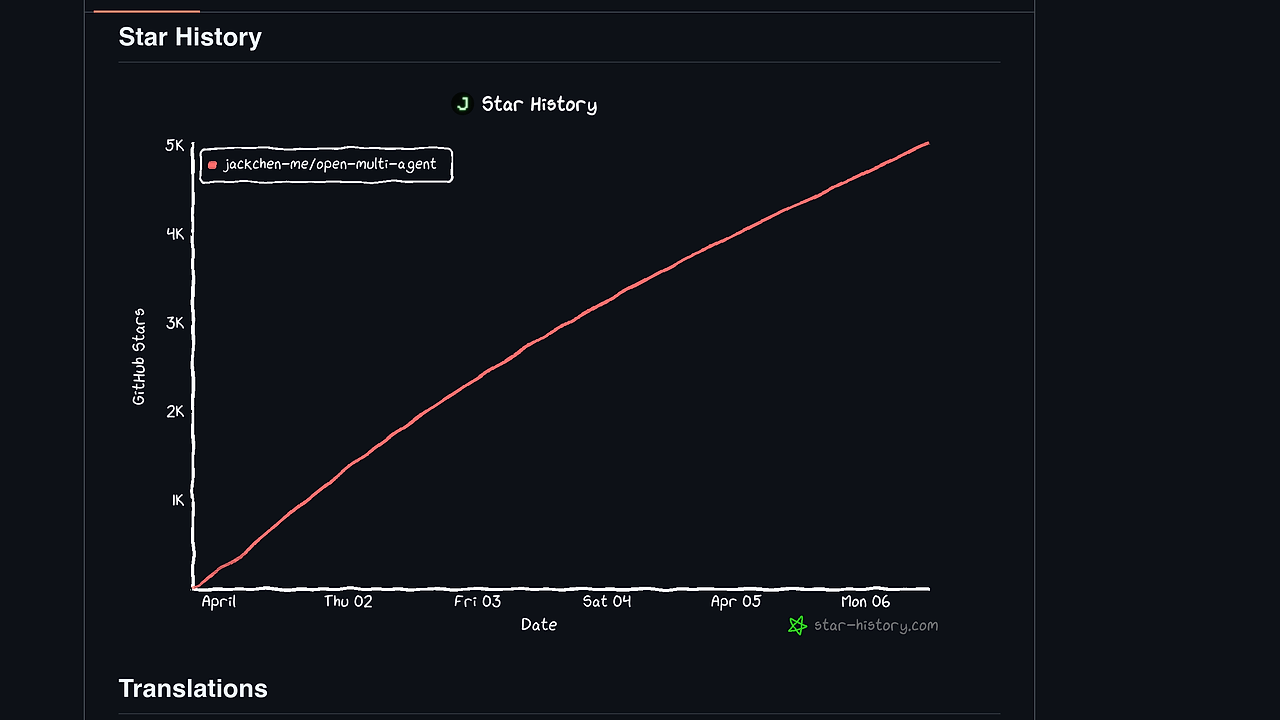
Open Multi-Agent is a TypeScript multi-agent orchestration framework built by JackChen-me. Open Multi-Agent is one of the best Multi-Agent Orchestration Frameworks tools for Node.js teams, AI engineers, and indie hackers because a single runTeam() call decomposes a goal into tasks, schedules dependencies, and executes agents in parallel; the GitHub repo had 5.3k stars as of Feb 2026, 84 commits, 33 source files, and only 3 runtime dependencies.
It is designed for teams that want agentic workflows inside the Node.js ecosystem instead of a Python sidecar or a custom coordinator service. The repo description makes the value proposition explicit: goal in, result out, with typed output, local model support, and enough surface area to read the code in an afternoon.
Quick Overview
| Attribute | Details |
|---|---|
| Type | Multi-Agent Orchestration Frameworks |
| Best For | Node.js teams, AI engineers, and indie hackers building agentic workflows |
| Language/Stack | TypeScript, Node.js, Zod, Anthropic/OpenAI SDKs, Ollama, vLLM, LM Studio, llama.cpp |
| License | MIT |
| GitHub Stars | 5.3k as of Feb 2026 |
| Pricing | Open-Source |
| Last Release | v0.1.0 — date not shown in repo text |
Who Should Use Open Multi-Agent?
- Node.js product teams shipping AI features inside Express, Next.js, or serverless apps that need orchestration without adding Python runtime baggage.
- AI engineers who want a task DAG, typed outputs, retries, and approval gates instead of a monolithic prompt chain.
- Indie hackers building internal tools, code assistants, research pipelines, or content workflows who need something readable and hackable fast.
- Platform teams that want model-agnostic agent runs across Claude, GPT, Gemma 4, and local backends without changing orchestration code.
Not ideal for:
- Teams that need a visual workflow builder and prefer drag-and-drop graphs over code.
- Projects already standardized on Python-only agent stacks where a Node.js framework adds friction.
- Simple single-prompt automation where a full DAG executor is unnecessary overhead.
Key Features of Open Multi-Agent
- Goal-to-DAG decomposition —
runTeam(team, "Build a REST API")turns a natural-language goal into a task graph with dependencies and assignees. Independent tasks run in parallel, so the coordinator does not serialize work that can be fanned out safely. - TypeScript-native runtime — Open Multi-Agent runs directly in Node.js with no subprocess bridge, no sidecar API, and no Python dependency. That makes it practical in Express handlers, Next.js route handlers, CI jobs, and short-lived serverless executions.
- Model-agnostic agent selection — The same team can mix Claude, GPT, Gemma 4, and local models such as Ollama, vLLM, LM Studio, and
llama.cppserver. Per-agentbaseURLsupport means you can route different roles to different backends without rewriting the workflow. - Structured outputs with Zod —
outputSchemaon an agent validates JSON output against a Zod schema, auto-parses the result, and retries once if the model returns invalid structure. Typed access viaresult.structuredkeeps downstream code predictable. - Retry and billing controls —
maxRetrieson tasks adds automatic retry with exponential backoff, and failed attempts accumulate token usage so cost accounting stays accurate. This matters when a downstream agent is expensive or when a tool call intermittently fails. - Human-in-the-loop approval —
runTasks()supports an optionalonApprovalcallback after each batch of tasks. That gives you a hard checkpoint before the remaining work continues, which is useful for destructive actions, release flows, or sensitive data access. - Lifecycle hooks and loop detection —
beforeRunandafterRunlet you modify prompts or post-process results, whileloopDetectioncatches agents stuck repeating the same output or tool calls. The default action is warn, but you can terminate or provide a custom handler.
Open Multi-Agent vs Alternatives
| Tool | Best For | Key Differentiator | Pricing |
|---|---|---|---|
| Open Multi-Agent | TypeScript-first multi-agent orchestration | runTeam() builds a task DAG, supports Zod-typed outputs, and runs in any Node.js runtime | Open-Source |
| OpenSwarm | Swarm-style agent coordination | Better fit if you want a different swarm abstraction or a broader agent coordination model | Open-Source |
| Brainstorm MCP | MCP-centric agent planning | Good when Model Context Protocol is the control plane and you want MCP-native workflows | Open-Source |
| Claude Code Canvas | Claude-centered coding sessions | Better for interactive single-assistant coding loops than DAG orchestration | Open-Source |
Pick OpenSwarm if your team prefers swarm terminology and you want to compare orchestration patterns across languages or runtimes. Pick Brainstorm MCP if your agents already speak MCP and you want the orchestration layer closer to that protocol.
Pick Claude Code Canvas when the workflow is mostly a human-plus-Claude editing loop instead of a dependency graph. If you need observability on top of any of these, pair the stack with OpenTrace so you can inspect agent runs, tool calls, and failure paths without guessing.
How Open Multi-Agent Works
Open Multi-Agent centers on a coordinator agent that takes a goal, breaks it into executable tasks, and attaches dependencies so the runtime knows what can run now versus what must wait. The design is opinionated: the framework prefers a small, readable TypeScript surface area over a plugin zoo, and the repository explicitly says the whole codebase is understandable in an afternoon.
The execution model uses parallel task scheduling, shared memory, and a message-bus style collaboration layer so agents can specialize without manually passing every intermediate result. A per-agent mutex prevents concurrent runs on the same agent instance, which avoids race conditions when the same agent object is reused across multiple tasks or recursive flows.
The framework also exposes practical control points for production use: AbortSignal cancels long-running orchestration, outputSchema keeps structured results sane, and loopDetection protects you from agents stuck in prompt or tool-call loops. That combination makes Open Multi-Agent closer to a real workflow engine than a demo-only agent wrapper.
import { createAgent, runTeam } from 'open-multi-agent';

const team = [
  createAgent({ id: 'planner', model: 'gpt-4o-mini' }),
  createAgent({ id: 'coder', model: 'claude-3-5-sonnet-latest' }),
  createAgent({ id: 'reviewer', model: 'gemma-4' })
];

const result = await runTeam(team, 'Build a REST API with auth and tests');
console.log(result.final);
This pattern asks the coordinator to split the goal, assign work to specialized agents, and synthesize a final answer. In practice, you should expect a planning step, one or more parallel task batches, and a merged final response that can be consumed by application code or another automation step.
Pros and Cons of Open Multi-Agent
Pros:
- TypeScript-native deployment keeps the runtime simple in Node.js, serverless functions, and CI jobs.
- Parallel execution reduces wall-clock time when tasks are independent.
- Zod-backed structured outputs make downstream parsing and validation deterministic.
- Model flexibility lets you mix cloud APIs and local inference servers in one team.
- Small dependency footprint lowers audit cost and reduces supply-chain noise.
- Readable codebase makes extension and debugging practical for small teams.
Cons:
- Node.js only means Python-first shops will pay an integration tax.
- No visual workflow editor forces you to define orchestration in code.
- Agent quality still depends on the underlying model; the framework cannot fix a weak model or a bad prompt.
- Production tuning is still your job for prompt discipline, tool boundaries, and observability.
- Some advanced orchestration patterns may require custom code rather than a higher-level declarative layer.
Getting Started with Open Multi-Agent
A practical first run is to install the package, create a small team, and execute a single goal through runTeam(). If you are already using TypeScript, install a runner such as tsx or compile with tsc; if you want quick smoke tests, a plain .mjs file is enough.
npm install open-multi-agent

cat > demo.mjs <<'EOF'
import { createAgent, runTeam } from 'open-multi-agent';

const team = [
  createAgent({ id: 'planner', model: 'gpt-4o-mini' }),
  createAgent({ id: 'implementer', model: 'claude-3-5-sonnet-latest' })
];

const result = await runTeam(team, 'Build a REST API with auth and tests');
console.log(result.final);
EOF

node demo.mjs
After that command finishes, Open Multi-Agent should print a synthesized result from the coordinator rather than raw model output. If you want typed payloads on the first try, add outputSchema; if you want guardrails around a sensitive step, add onApproval or AbortSignal before wiring the tool into production.
Verdict
Open Multi-Agent is the strongest option for Node.js-native agent orchestration when you want typed outputs, parallel task execution, and model flexibility without a Python runtime. Its biggest strength is the small, auditable TypeScript surface area; its main caveat is that orchestration still requires code discipline. Use it when you need real control, not a toy wrapper.