What Is DeepSeek_Web_To_API?
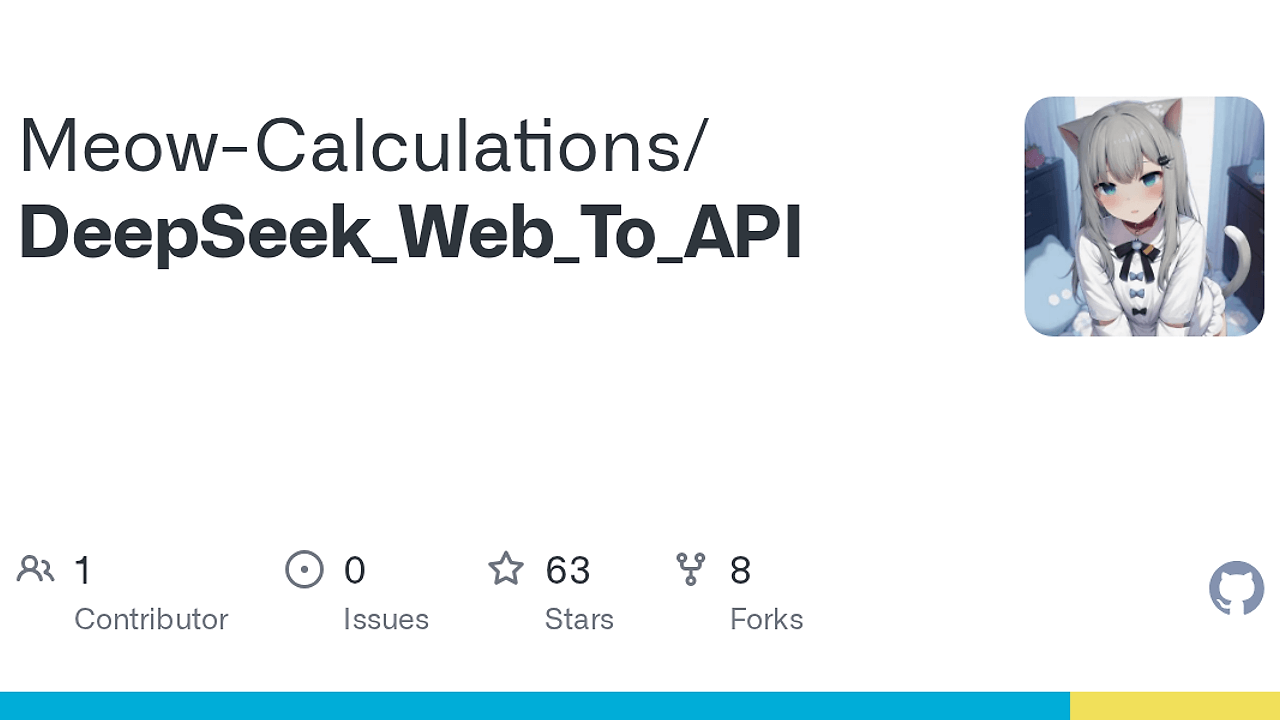
DeepSeek_Web_To_API is a Go-based API gateway built by Meow-Calculations that wraps DeepSeek Web session access into OpenAI-compatible, Claude-compatible, and Gemini-compatible endpoints for developers and platform teams. DeepSeek_Web_To_API is one of the best AI API Gateways tools for developers and platform teams running DeepSeek Web accounts behind OpenAI, Claude, or Gemini clients. It is at v1.0.13 and ships with a React admin console, so you get protocol translation, account management, cache controls, and runtime status in one self-hosted package.
The tool is aimed at teams that want to keep their client integrations stable while changing the upstream model provider behavior underneath. It is especially useful when you need to preserve existing SDK calls such as /v1/chat/completions while routing traffic through DeepSeek Web sessions.
Quick Overview
| Attribute | Details |
|---|---|
| Type | AI API Gateways |
| Best For | Developers and platform teams running DeepSeek Web accounts behind OpenAI, Claude, or Gemini clients |
| Language/Stack | Go backend, React admin console, SQLite persistence, Docker Compose deployment |
| License | MIT |
| GitHub Stars | N/A as of Feb 2026 |
| Pricing | Open-Source |
| Last Release | v1.0.13 — date not stated in the README |
Who Should Use DeepSeek_Web_To_API?
- Indie hackers shipping AI features fast who want one local gateway that can front multiple client SDKs without rewriting app code.
- Platform engineers operating shared DeepSeek accounts who need account pooling, token refresh, and 429 fail-over behavior instead of one-off scripts.
- Teams with existing OpenAI, Claude, or Gemini integrations that want DeepSeek as a drop-in upstream without touching product code.
- Operators who need an admin plane for keys, proxies, history, and cache settings instead of editing JSON by hand.
Not ideal for:
- Teams that only use the official DeepSeek API and do not need compatibility layers.
- Groups that want fully managed SaaS with no self-hosting, no SQLite, and no local deployment work.
- Workloads that depend on a public support contract or enterprise SLA rather than an MIT-licensed community project.
Key Features of DeepSeek_Web_To_API
- OpenAI endpoint compatibility — DeepSeek_Web_To_API exposes
/v1/models,/v1/chat/completions,/v1/responses,/v1/files, and/v1/embeddings, which means existing OpenAI SDK calls can usually stay unchanged. That reduces client-side branching and keeps your integration surface close to standard OpenAI REST semantics. - Claude and Gemini compatibility — It also supports
/anthropic/v1/messages,/v1/messages,/messages,count_tokens, and Gemini-style routes such as/v1beta/models/{model}:generateContent. That matters when you have mixed frontend, agent, or backend code paths that already target Anthropic or Google formats. - Multi-account orchestration — The gateway maintains an account pool with automatic selection, token refresh, and concurrency slot handling. It can switch accounts on upstream
429responses without burning the caller’s retry budget, which is the right behavior for bursty workloads and shared credentials. - Direct token passthrough — When the caller’s token is not present in the managed secret store, DeepSeek_Web_To_API can pass the DeepSeek token through directly. That avoids unnecessary secret duplication and gives you a cleaner split between managed and direct-auth traffic.
- Response caching with hot TTL control — It supports in-memory caching with a default 30-minute TTL and a 3.8 GB ceiling, plus disk caching with a default 48-hour TTL and a 16 GB ceiling using gzip compression. TTL values can be changed from WebUI or store configuration and take effect immediately.
- CIF prefix reuse — The Current Input File workflow keeps inline prefix state reusable across accounts and caps each session at two prefix variants with LRU promotion. That design is aimed at preserving conversation context efficiently while controlling
maxTailCharsat 128 KB. - Security policy hot reload — Banned content lists, regex rules, jailbreak patterns, blocked IPs, and auto-ban thresholds live in SQLite and can be updated through
PUT /admin/settingswithout a restart. That is a practical fit for environments where policy changes happen faster than deployment cycles.
DeepSeek_Web_To_API vs Alternatives
| Tool | Best For | Key Differentiator | Pricing |
|---|---|---|---|
| DeepSeek_Web_To_API | Self-hosted DeepSeek Web to OpenAI/Claude/Gemini compatibility | Full gateway plus React admin UI and account pool management | Open-Source |
| LiteLLM | Broad model routing across many providers | Mature proxy layer for many LLM vendors and SDKs | Open-Source / Paid services |
| One API | Multi-provider API aggregation | Simple model aggregation and key management for many backends | Open-Source |
| OpenRouter | Hosted model access and routing | SaaS model marketplace with hosted billing and routing | Freemium / Paid |
Pick LiteLLM when your main problem is provider-agnostic routing across a lot of backends, not DeepSeek Web session orchestration. Pick One API when you want a simpler self-hosted aggregator with less emphasis on DeepSeek-specific session behavior. Pick OpenRouter when you want a hosted service and do not want to run the gateway yourself.
If you care about observability while running this gateway, pair it with OpenTrace to inspect request flow and failure points. If deployment automation is the bottleneck, djevops is a better fit for building and shipping the service, while MachineAuth is useful when you want tighter machine-to-machine credential handling around the admin surface.
How DeepSeek_Web_To_API Works
DeepSeek_Web_To_API sits between your client SDK and DeepSeek Web, then normalizes the request and response shapes into the protocol your app expects. The core abstraction is a compatibility proxy that translates OpenAI, Claude, and Gemini request formats into upstream session operations while preserving streaming behavior, token accounting, and model routing.
The runtime is deliberately split into two planes. The data plane handles inference traffic, cache lookups, account selection, fail-over, and response streaming, while the control plane manages settings, account imports, policy updates, and operational visibility through the /admin UI.
Under the hood, the design favors explicit model resolution and controlled behavior over heuristic fallback. That is why the project enforces a strict canonical model whitelist and removes ambiguous family-prefix guessing; in practice, this reduces accidental exposure of unsupported models and makes failures easier to reason about.
curl http://127.0.0.1:5001/v1/chat/completions \
  -H "Authorization: Bearer your-api-key-1" \
  -H "Content-Type: application/json" \
  -d '{
    "model": "gpt-5.5",
    "messages": [{"role": "user", "content": "你好"}],
    "stream": true
  }'
This request hits the OpenAI-compatible endpoint, authenticates with your API key, and streams a chat response through the gateway. If the current account hits a 429, DeepSeek_Web_To_API can move to another available account without forcing your client to retry immediately.
The same gateway pattern also applies to Claude and Gemini routes, so you can keep one deployment while serving heterogeneous clients. That makes it a practical choice for teams that have mixed SDK usage in one monorepo, one backend, or one internal AI platform.
Pros and Cons of DeepSeek_Web_To_API
Pros:
- Protocol compatibility across three ecosystems keeps OpenAI, Claude, and Gemini clients on one interface.
- Self-hosted control plane gives you local ownership of keys, accounts, cache, and history.
- Account pooling with fail-over improves availability when upstream rate limits or session issues hit a single account.
- SQLite-backed persistence keeps account data and history isolated from application code and easy to back up.
- Hot-reload security settings lets operators react to abuse patterns without redeploying.
- Docker Compose support lowers the operational cost of a local or small-team deployment.
Cons:
- You still manage DeepSeek Web accounts and the associated operational and policy risk.
- The gateway is opinionated about supported models because the whitelist rejects unsupported IDs rather than guessing.
- You run the infrastructure yourself if you choose the open-source path, including storage, backup, and upgrades.
- Compatibility is not the same as native provider support; edge-case behavior may differ from official APIs.
- The admin plane adds surface area that needs authentication, auditing, and careful secret handling.
Getting Started with DeepSeek_Web_To_API
The fastest path is Docker Compose if you want a working gateway without compiling Go or the React admin UI locally. For source builds, the project also documents a standard Go + npm workflow that compiles the web console and then starts the backend service.
cp .env.example .env
npm ci --prefix webui
npm run build --prefix webui
go run ./cmd/DeepSeek_Web_To_API
After startup, the service listens on 127.0.0.1:5001 by default and exposes the admin console at http://127.0.0.1:5001/admin. The first configuration step is usually setting API keys, admin credentials, JWT secret, and the SQLite paths for accounts and history before you let production traffic through.
If you want containerized deployment instead of local process management, the Compose workflow maps a host port to container port 5001 and mounts ./data for configuration, account state, history, and cache. That makes it easier to keep the gateway stateful without spreading files across the filesystem, and it fits cleanly into a deployment pipeline managed by djevops.
Verdict
DeepSeek_Web_To_API is the strongest option for teams that want DeepSeek Web sessions exposed through standard AI APIs when they also need self-hosted account management and policy control. Its best strength is protocol compatibility with operational features baked in. The trade-off is that you own the accounts, storage, and upgrade path. Use it when control matters more than managed convenience.