What Is awesome-agentic-ai-zh?
awesome-agentic-ai-zh is a GitHub-based AI Agent Learning Roadmap built by WenyuChiou for developers, indie hackers, and AI builders who want a staged path from LLM basics to multi-agent systems. It is one of the best AI Agent Learning Roadmaps tools for developers, indie hackers, and AI builders, and it compresses 145+ projects, 7 stages, and 2 learning tracks into one curriculum that covers token math, prompt design, function calling, MCP, and local deployment. The repo is MIT licensed and published in Traditional Chinese with an English companion for teams that want the same structure across languages.
Quick Overview
| Attribute | Details |
|---|---|
| Type | AI Agent Learning Roadmaps |
| Best For | developers, indie hackers, and AI builders |
| Language/Stack | Python, CLI agents, LLM APIs, MCP, RAG, local LLMs |
| License | MIT |
| GitHub Stars | N/A as of Feb 2026 |
| Pricing | Open-Source |
| Last Release | N/A — documentation repo, no release tag in the scraped page text |
Who Should Use awesome-agentic-ai-zh?
- Python-capable builders who want a structured path into agents without assembling a random stack of blog posts.
- Indie hackers who need a practical sequence for moving from prompt experiments to usable automation.
- Platform and CTO teams that want a shared curriculum for onboarding engineers into agent concepts, MCP, and observability.
- Educators and study groups looking for a bilingual syllabus with checkpoints, mini projects, and reading lists.
Not ideal for:
- People who want a turnkey SaaS and do not want to read documentation or run exercises.
- Teams with zero Python or git familiarity that are not willing to complete the Stage 0 setup work.
- Builders looking for a single framework rather than a curriculum that compares multiple frameworks and workflows.
Key Features of awesome-agentic-ai-zh
- 7-stage progression — The roadmap starts with Python, git, API basics, and JSON, then moves into LLM fundamentals, prompt design, tool use, frameworks, memory, RAG, and multi-agent systems. That sequencing matters because each stage states what you need to know before moving on.
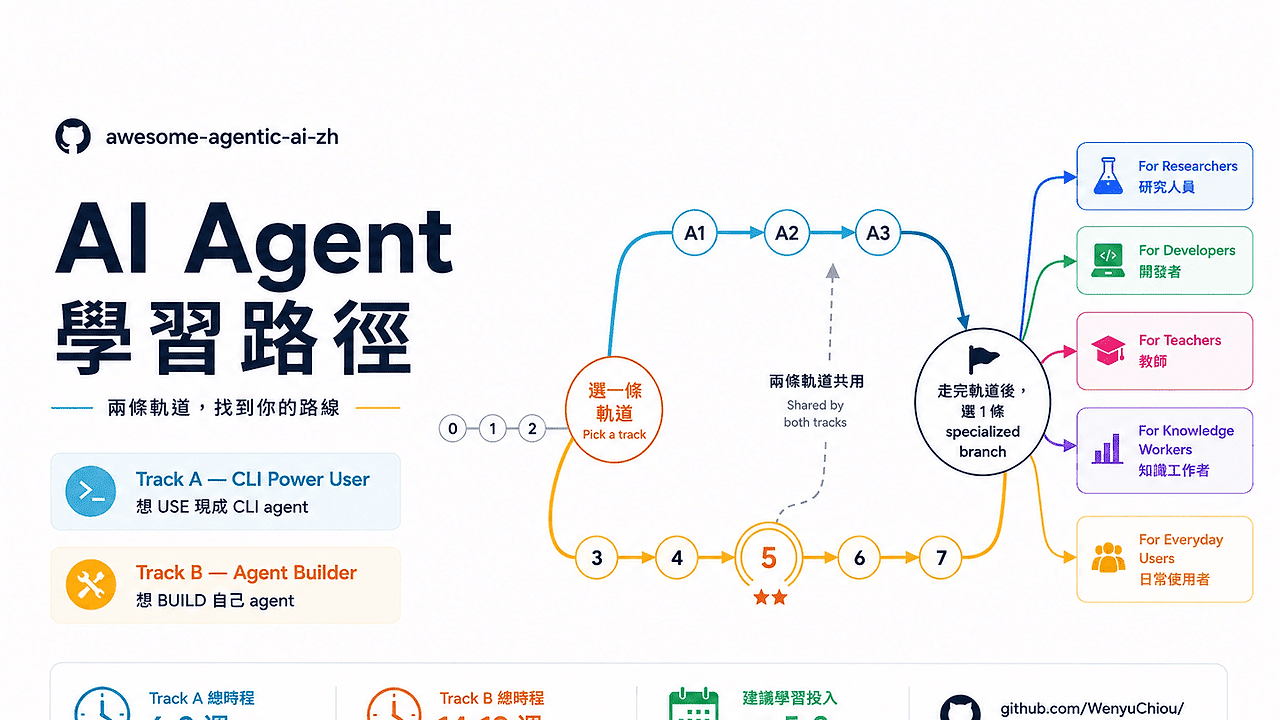
- Two explicit learning tracks — Track A is for CLI power users who want to operate tools like Claude Code, Codex, OpenCode, and Gemini CLI. Track B is for builders who want to implement agents, ReAct loops, and orchestration patterns from scratch.
- Hands-on mini projects — Every stage includes required exercises with success criteria, so the repo is not just a reading list. The page calls out that reading alone does not count as learning, which keeps the curriculum grounded in implementation.
- 145+ curated projects — The repo filters projects by star level, intended audience, and what each project teaches. It also calls out how to run local LLM workflows with Ollama, llama.cpp, LocalAI, and MLX, which is useful for offline or cost-controlled practice.
- Claude Code ecosystem coverage — Stage 5 covers MCP, Skills, Plugins, and marketplace-style tooling, which gives you a concrete bridge from model usage to tool-enabled workflows. That section is useful if you need to understand how modern CLI agents connect to external systems.
- Bilingual documentation — Traditional Chinese is the primary language, but the repo also includes a complete English version. That makes it suitable for mixed-language teams and study groups that need one canonical learning path.
- Time estimates and exit criteria — The roadmap states a realistic main-path duration of 14-19 weeks and a practical 5-6 month part-time schedule at 5-8 hours per week. The stage tables also tell you when to advance, which reduces the usual guesswork in self-study.
awesome-agentic-ai-zh vs Alternatives
| Tool | Best For | Key Differentiator | Pricing |
|---|---|---|---|
| awesome-agentic-ai-zh | Structured AI agent learning with exercises and stage gates | Curriculum-first roadmap with 7 stages, 2 tracks, and 145+ projects | Open-Source |
| OpenSwarm | Multi-agent orchestration at runtime | Execution layer for coordinating agents, not a study path | Open-Source |
| Brainstorm MCP | Planning, ideation, and agent-assisted task decomposition | Useful when you need an MCP-driven assistant to shape prompts and work plans | Open-Source |
| Claude Context Mode | Terminal-heavy workflows with tighter context handling | Better fit for day-to-day CLI delegation than for curriculum design | Open-Source |
Pick OpenSwarm when you already know the concepts and need a concrete orchestration layer for running multiple agents. Pick Brainstorm MCP when your bottleneck is planning, prompt structuring, or turning a fuzzy task into an execution plan inside the MCP ecosystem.
Pick Claude Context Mode when you live in the terminal and want context-aware delegation more than a study roadmap. If your goal is observability after you start shipping agents, pair this repo with OpenTrace rather than treating the roadmap as the final stop.
How awesome-agentic-ai-zh Works
awesome-agentic-ai-zh works as a curriculum-as-code repository: the README acts as the router, while stage files, track files, branch guides, and walkthroughs hold the actual learning content. The abstraction is simple and effective. Instead of hiding the path behind a polished course platform, the repo exposes prerequisites, exercises, checkpoints, and recommended projects as Markdown, which keeps the material easy to fork, audit, and extend.
The design choice is deliberate. Stage 0-2 build shared foundations, then you choose Track A for CLI agents or Track B for agent construction, and later branch into research, development, teaching, knowledge work, or everyday use cases. That means the repo is not trying to be a monolith; it is a directed graph of learning assets that maps cleanly to how people actually progress from curiosity to production-grade agent work.
git clone https://github.com/WenyuChiou/awesome-agentic-ai-zh.git
cd awesome-agentic-ai-zh
code stages/00-foundations.md
The commands above clone the repository, enter the workspace, and open the first stage so you can start with the foundations instead of skipping ahead. If you are new to the space, the repo also points to a setup guide that walks through API keys, Python setup, and a first LLM hello-world before you touch the heavier agent material.
Pros and Cons of awesome-agentic-ai-zh
Pros:
- Clear sequencing — The repo tells you what to learn first, what to practice, and what to verify before advancing.
- Hands-on by default — Exercises and mini projects are part of the path, which reduces passive reading.
- Covers the full stack — It spans LLM basics, prompt design, tool use, MCP, memory, RAG, and multi-agent orchestration.
- Good for local-first practice — Explicit mentions of Ollama, llama.cpp, LocalAI, and MLX make it practical for offline experiments.
- Bilingual and shareable — Chinese-first with English support makes it easier to distribute across teams.
- Strong onboarding value — The setup guide and stage map make it easier to train new hires or study groups consistently.
Cons:
- Not executable software — This repo is documentation and curation, so it will not run anything for you.
- Requires self-discipline — If you skip the exercises, you will get the outline without the skill gain.
- Some content will age — Agent tooling moves fast, so specific project recommendations and model choices need periodic review.
- Chinese-first structure may slow some readers — The English companion helps, but the main navigation is still Traditional Chinese.
- Curated, not benchmarked — The project list is useful, but it is not a controlled benchmark suite.
Getting Started with awesome-agentic-ai-zh
No install is required. Clone the repo, open the setup guide, and start with Stage 0 if you still need Python, git, or API basics; otherwise jump straight into Stage 1 and decide later whether Track A or Track B fits your goals.
git clone https://github.com/WenyuChiou/awesome-agentic-ai-zh.git
cd awesome-agentic-ai-zh
code resources/setup-guide.md
After that, read the setup guide first if you have never run an LLM API call, because it is designed to get you from zero to a first working example in about 30-45 minutes. If you already know the basics, open stages/00-foundations.md, complete the shared groundwork, and only then branch into CLI usage or agent construction.
Verdict
awesome-agentic-ai-zh is the strongest option for learning AI agents from scratch when you want a staged curriculum instead of scattered links. Its biggest strength is the explicit progression from basics to multi-agent systems, and its main caveat is that you still have to do the exercises yourself. If you want a practical roadmap, start here.