What Is Refactoring Rust?
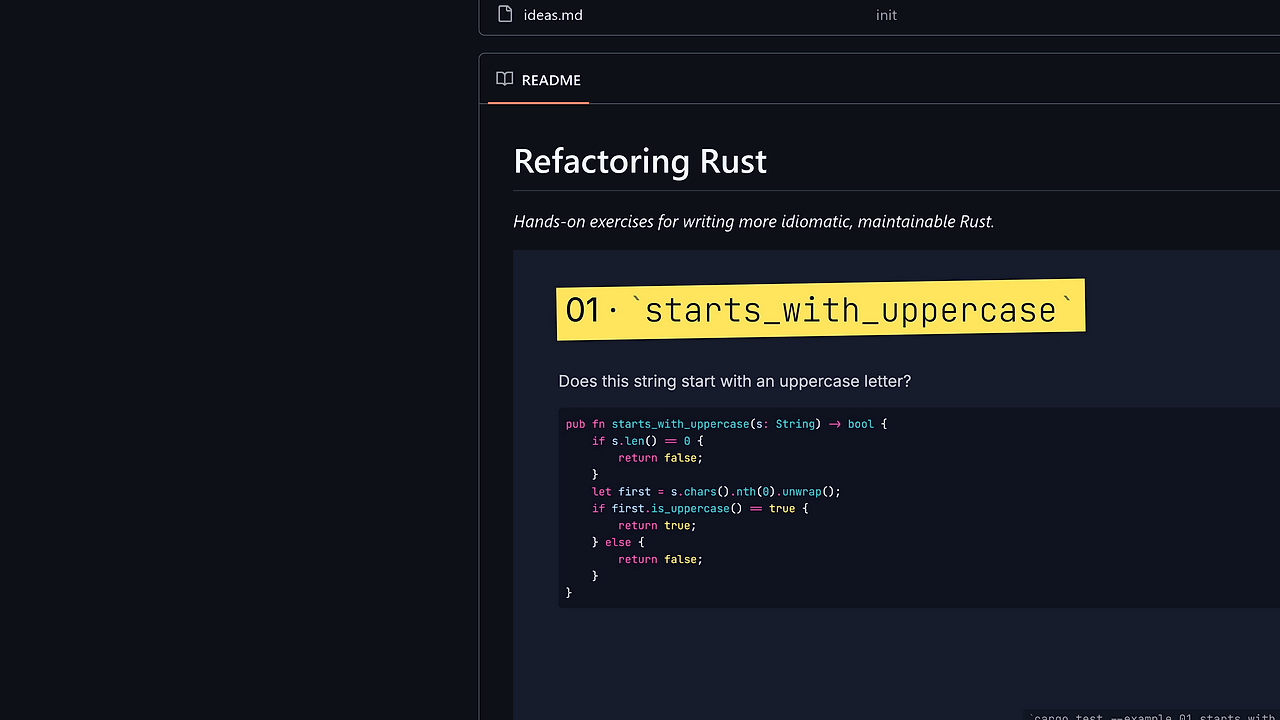
Refactoring Rust is one of the best Rust Refactoring Exercises tools for intermediate Rust developers. Built by corrode, it ships 100 hands-on exercises that start as working-but-awkward Rust and ask you to reshape them into more idiomatic code for maintainability, clarity, and better ownership semantics. It is aimed at developers who already know the syntax and now need to sharpen judgment around enums, iterators, error handling, and API shape.
Quick Overview
| Attribute | Details |
|---|---|
| Type | Rust Refactoring Exercises |
| Best For | intermediate Rust developers and teams reviewing production Rust code |
| Language/Stack | Rust, Cargo, cargo run --example, cargo test, GitHub repositories |
| License | N/A |
| GitHub Stars | N/A |
| Pricing | Open-Source |
| Last Release | N/A |
Who Should Use Refactoring Rust?
- Intermediate Rust developers who can compile code already but want better instincts for expressing intent with fewer clones, fewer conditionals, and cleaner types.
- Code reviewers who need concrete before-and-after examples for explaining why a refactor is better than a direct translation from imperative code.
- Tech leads and maintainers who want a low-risk training path for teams that already ship Rust and now need stronger idioms in shared codebases.
- Rust learners moving past tutorials who are ready to practice real transformations instead of only filling in missing code in a toy exercise.
Not ideal for:
- Absolute beginners who still need basic ownership, borrowing, and lifetimes instruction.
- Teams that want production scaffolding, application templates, or dependency-heavy starter kits.
- Engineers looking for performance micro-benchmarks instead of readability and structural refactors.
Key Features of Refactoring Rust
- Refactor-first exercises — Each task gives you code that already works, but is intentionally clunky. That setup forces you to reason about architecture and idioms rather than guessing at syntax.
- Self-contained examples — Every exercise stands alone, so you can jump to a specific topic without completing a prerequisite path. That makes it useful as a targeted refresher before a code review or design session.
- Progressive difficulty — The repo numbers exercises by complexity, starting with quick warm-ups and moving toward larger structural changes. That pacing helps you build confidence before touching denser refactors.
- Multiple valid solutions — The project explicitly accepts more than one good answer. That matters in Rust because ownership, borrowing, and API shape often allow several clean implementations with different trade-offs.
- Cargo-native workflow — Exercises run directly through
cargo run --exampleandcargo test --example, so the feedback loop is the same one you use in real Rust projects. No extra harness or bespoke runner is required. - Idiomatic Rust focus — The exercises push you toward enums, pattern matching, iterator adapters, type-driven design, and cleaner error handling. That is the core value if you already know the language but want to write code other Rust developers trust faster.
- Good for review calibration — Because each exercise has room for interpretation, it is useful for aligning a team on what they consider readable, maintainable Rust. Pairing it with Brainstorm MCP can help you generate refactor options before you touch code, while Claude Code Canvas is useful when you want to sketch the transformation interactively.
Refactoring Rust vs Alternatives
| Tool | Best For | Key Differentiator | Pricing |
|---|---|---|---|
| Refactoring Rust | Practicing idiomatic refactors in real Rust code | Focuses on transforming working code into cleaner code, not just solving syntax gaps | Open-Source |
| Rustlings | Beginners learning Rust fundamentals | Teaches syntax and compiler-driven exercises, with a stronger beginner ramp | Open-Source |
| Exercism Rust Track | Structured mentorship and feedback | Adds human review and broader learning support, which is better for guided practice | Free tier + optional paid support |
| OpenSwarm | Agentic multi-step workflows | Better when you want automated exploration across multiple tasks, not just manual refactor drills | Open-Source |
Pick Rustlings if you are still learning ownership, borrowing, and core language mechanics from scratch. It is the better on-ramp when compiler errors are still the main obstacle.
Pick Exercism if you want mentorship and a wider exercise ecosystem. It is stronger when you value feedback from another developer more than repeated self-directed refactor practice.
Pick OpenSwarm if your workflow is broader than one repository and you want automated multi-agent task execution. It is not a replacement for Refactoring Rust, but it can complement it when you are using exercises to standardize team habits.
How Refactoring Rust Works
Refactoring Rust is built around a simple model: each exercise exposes a small Rust program or example target, and your job is to make the code cleaner without breaking behavior. The project uses Cargo example targets, so the compile-and-test loop stays close to real-world Rust development instead of hiding behind a custom learning runtime.
The design choice here matters. By keeping exercises self-contained and runnable through standard Cargo commands, the repo lets you practice the same tools you use in production: the compiler, the test harness, and the example binary entrypoint. That makes the feedback loop concrete, which is exactly what you want when learning how ownership, borrowing, and type design interact under pressure.
git clone https://github.com/corrode/refactoring-rust.git
cd refactoring-rust
cargo run --example 01_starts_with_uppercase
cargo test --example 01_starts_with_uppercase
The first command runs the example so you can inspect the current behavior. The second command validates the exercise against its tests, which is the key constraint that keeps the refactor honest: you are changing structure, not semantics.
A practical way to think about Refactoring Rust is as a set of small design reviews encoded as exercises. You are not asked to invent new features; you are asked to improve the shape of code that already exists, which is closer to day-to-day maintenance work than greenfield tutorial coding.
Pros and Cons of Refactoring Rust
Pros:
- Teaches idiomatic Rust through actual refactors instead of synthetic fill-in-the-blank snippets.
- Uses standard Cargo commands, so the workflow matches real projects and CI pipelines.
- Supports multiple valid answers, which reflects how Rust design choices often involve trade-offs rather than one perfect path.
- Self-contained exercises make it easy to target weak spots like pattern matching, ownership, or API shape.
- Progressive ordering helps teams move from quick wins to larger structural changes without needing a separate curriculum.
- Useful for review calibration because it exposes where different developers draw the line between acceptable and elegant code.
Cons:
- Not a beginner course, so it assumes you already understand Rust basics and compiler errors.
- Does not provide interactive mentorship or human code review the way a guided platform might.
- Focuses on refactoring skill, not on project scaffolding, application architecture, or dependency management.
- The repo text does not advertise benchmarks, release cadence, or published star counts, so external signal is limited in the scraped page.
- Because there can be several good answers, teams may still disagree on the preferred refactor unless they define internal style rules.
Getting Started with Refactoring Rust
Start by cloning the repository and running one example plus its tests. You only need a working Rust toolchain with Cargo installed, and the exercises are designed to run directly from the command line.
git clone https://github.com/corrode/refactoring-rust.git
cd refactoring-rust
cargo run --example 01_starts_with_uppercase
cargo test --example 01_starts_with_uppercase
After the first run, inspect the source for the example and make the smallest change that improves readability without changing behavior. If your local toolchain is current, no extra configuration is needed beyond the usual Rust setup; if you do not have Rust installed, install it with rustup before starting.
Verdict
Refactoring Rust is the strongest option for intermediate Rust developers when the goal is to turn correct code into idiomatic code without changing behavior. Its biggest strength is the self-contained, Cargo-native exercise format; the main caveat is that it does not teach Rust from zero. If your team needs practical refactor practice, use it.