What Is AIEden?
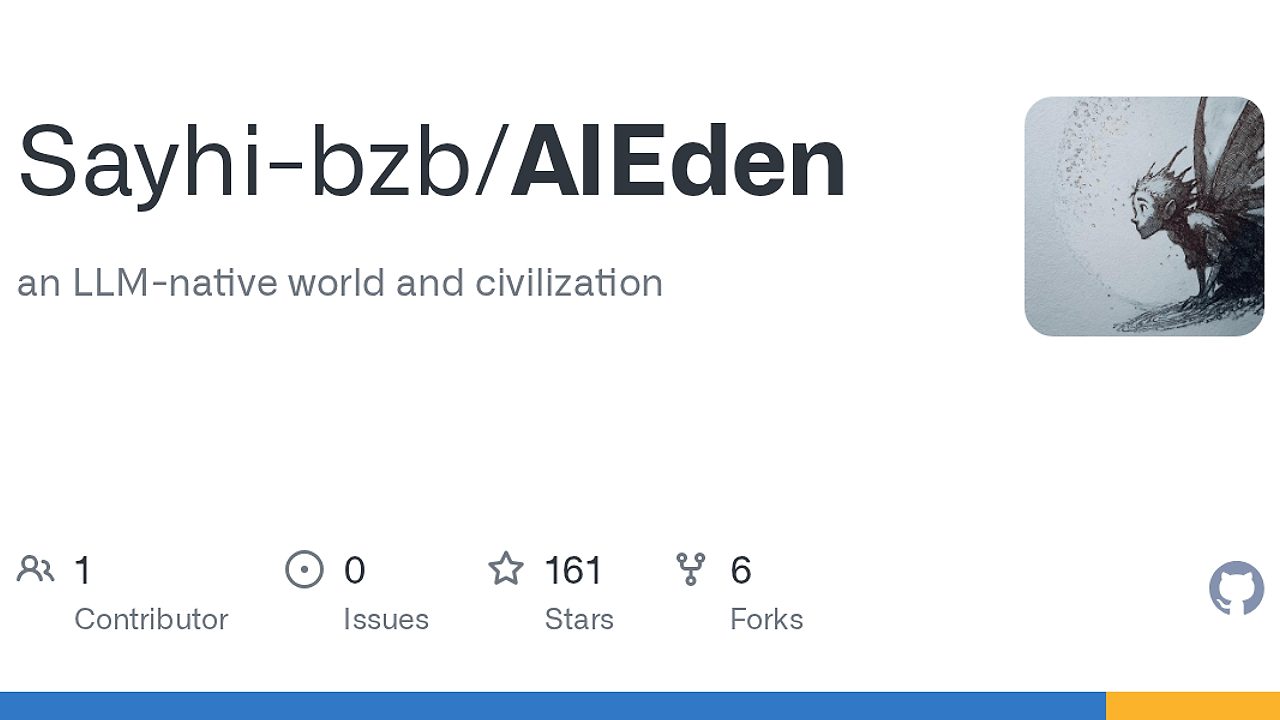
AIEden is an early beta blueprint from Sayhi-bzb that defines a continuous LLM-shaped subject inside a bounded causal world for developers building agent runtimes, simulations, and text-native environments. AIEden is one of the best AI Agent Frameworks tools for LLM builders and agent researchers; the repo currently maps 3 top-level areas, blueprint/, packages/documation/, and policy/, and it is not yet a stable runtime, SDK, API, or published package.
The design center is not task completion. It is continuity, where an agent keeps territory, inboxes, assets, and causal traces across time instead of resetting after each prompt. That makes AIEden closer to a model of agent life than to a normal orchestration library.
Quick Overview
| Attribute | Details |
|---|---|
| Type | AI Agent Frameworks |
| Best For | LLM builders and agent researchers |
| Language/Stack | Linux-like shells, Bash agents, text-based causal worlds |
| License | Unspecified in the scraped page |
| GitHub Stars | N/A — not exposed in the scraped text |
| Pricing | Open-Source |
| Last Release | N/A — blueprint only in the scraped page |
Who Should Use AIEden?
- Research teams studying emergent agent behavior who want to inspect how persistent subjects develop territory, inboxes, and communication patterns inside a bounded text environment.
- Indie hackers building experimental agent sims who care more about agent continuity and causal traces than shipping a polished SDK on day one.
- Platform engineers evaluating next-gen agent architecture who need a blueprint for stateful, traceable, life-loop-based agents rather than one-shot automation.
- Toolmakers working on shell-native LLM workflows who want a reference design for how Bash agents can accumulate memory and action history over time.
Not ideal for:
- Teams that need a production-ready runtime today.
- Teams that want a drop-in API with stable package installs and versioned releases.
- Product groups looking for a conventional task bot instead of a continuous agent subject.
Key Features of AIEden
- Life loop over task loop — AIEden is built around the idea that an agent should persist as a continuous life process, not just answer prompts. That shifts design toward identity, memory, and time-based continuity instead of stateless execution.
- Bounded perception — The agent only knows what the world surfaces through its textual boundary. That constraint matters because it forces a realistic model of partial observability, similar to a terminal session or sandboxed process.
- Embodied action — AIEden treats shell commands, filesystem changes, inbox writes, and asset manipulation as first-class actions. That gives the model a causal footprint rather than a purely conversational transcript.
- Trace-first causality — The repo emphasizes causal traces, which means the sequence of actions matters as much as the final output. That is useful if you need post-hoc analysis, replay, or debugging of agent decisions.
- Continuity before convenience — Instead of optimizing for immediate developer ergonomics, AIEden prioritizes persistent state and long-lived subjecthood. That is the right trade-off if you are researching agent coherence across sessions.
- Linux-like environment origin — The project originated from experiments where several LLM Bash agents were placed inside Linux-like environments and allowed to explore through the command line. That origin matters because it ties the architecture to real terminal constraints instead of abstract chat-only workflows.
- Blueprint-driven structure — AIEden exposes its direction through design notes, especially
blueprint/setting.md, rather than hiding the architecture behind a binary release. That makes it easier to audit the intended mental model before building on top of it.
AIEden vs Alternatives
| Tool | Best For | Key Differentiator | Pricing |
|---|---|---|---|
| AIEden | Researching persistent agent identity and causal continuity | Blueprint for a continuous subject, not a task bot | Open-Source |
| OpenSwarm | Multi-agent orchestration and swarm-style workflows | More focused on coordination and execution than on life-loop theory | Open-Source |
| AutoGPT | General-purpose autonomous task execution | More mature public ecosystem and broader awareness | Open-Source |
| LangGraph | Stateful agent graphs and durable workflows | Stronger production-oriented graph control and integration surface | Open-Source |
Pick OpenSwarm if you need something that looks closer to a runnable agent swarm today. Pick OpenTrace if your main problem is capturing, inspecting, and replaying agent decisions after the fact, because AIEden is heavily trace-shaped even if it is still a blueprint.
Pick AutoGPT if you want a well-known baseline for autonomous task loops and you are comparing public agent ecosystems. Pick LangGraph if you need graph-based control flow, branching, retries, and stronger operational structure than AIEden currently documents.
If your workflow sits closer to prompt planning or context shaping than to agent life simulation, Brainstorm MCP and Claude Context Mode solve a different layer of the stack. AIEden is the architectural thought experiment; those tools are better for active coding workflows and context management.
How AIEden Works
AIEden works by modeling an agent as a bounded subject that perceives, acts, and leaves traces inside a textual world. The core abstraction is the life loop, which puts continuity ahead of single-shot task completion and treats each interaction as part of a longer causal chain.
The architecture implied by the repo is simple but opinionated. Perception is bounded, action is embodied through terminal-like operations, and every meaningful change should produce a trace that can be inspected later. That is a strong fit for researchers who want to study agent identity, state accumulation, and the failure modes of long-running LLM behavior.
The repository does not present a shippable runtime, so the practical way to use AIEden right now is to inspect the blueprint and reason about the design contract. A minimal exploration flow looks like this:
git clone https://github.com/Sayhi-bzb/AIEden
cd AIEden
sed -n '1,200p' blueprint/setting.md
find blueprint packages policy -maxdepth 2 -type f | sort
That sequence clones the repo, reads the main design note, and lists the documented workspace layout. Expect architecture notes, policy placeholders, and documentation scaffolding rather than an installable binary or a fully wired SDK.
Pros and Cons of AIEden
Pros:
- Clear conceptual model — The life-loop framing is sharper than vague agent-autonomy marketing, which makes architectural trade-offs easier to evaluate.
- Trace-centric design — Causal traces are a better debugging primitive than ad hoc chat logs when you need to understand long-lived behavior.
- Built for persistence — AIEden treats continuity as a first-class problem, which is where many agent systems fail in practice.
- Terminal-native origin — Bash and Linux-like environments are practical sandboxes for testing agent autonomy under real constraints.
- Blueprint transparency — The repo exposes its direction openly, so you can assess the idea without guessing at hidden implementation details.
Cons:
- Not production-ready — The repo explicitly says it is not yet a stable runtime, SDK, API, or published package.
- No installable artifact — There is no obvious pip package, npm module, or release pipeline in the scraped text.
- Incomplete ecosystem — There is no documented plugin story, integration surface, or versioned compatibility matrix yet.
- Research-first bias — The design is optimized for conceptual clarity and experimentation, not immediate shipping velocity.
- Unknown licensing detail — The scraped page does not expose a license, so legal reuse needs a separate review before adoption.
Getting Started with AIEden
AIEden does not currently ship as a standard installable package, so the fastest start is to clone the repo and inspect the blueprint directly. That gives you the design contract before you decide whether to prototype on top of it or reuse the ideas in your own agent system.
git clone https://github.com/Sayhi-bzb/AIEden
cd AIEden
ls
sed -n '1,220p' blueprint/setting.md
After running those commands, focus on the design note and the workspace map. The main initial work is not configuration of an app, but interpretation of the architecture: how perception is bounded, how action becomes traceable, and how continuity is preserved across sessions.
If you want to turn the blueprint into code, start by defining the state model, the action log, and the replay format. That is the shortest path from AIEden the concept to AIEden the runtime, and it keeps the causal model visible from the first prototype.
Verdict
AIEden is the strongest option for researchers and builders who want a continuous agent subject when the goal is understanding persistence, not shipping a task bot. Its biggest strength is the life-loop and trace-first framing; its biggest caveat is that it is still a blueprint with no stable runtime. Use it as an architectural reference, not as a production dependency.