What Is cve-2026-31431?
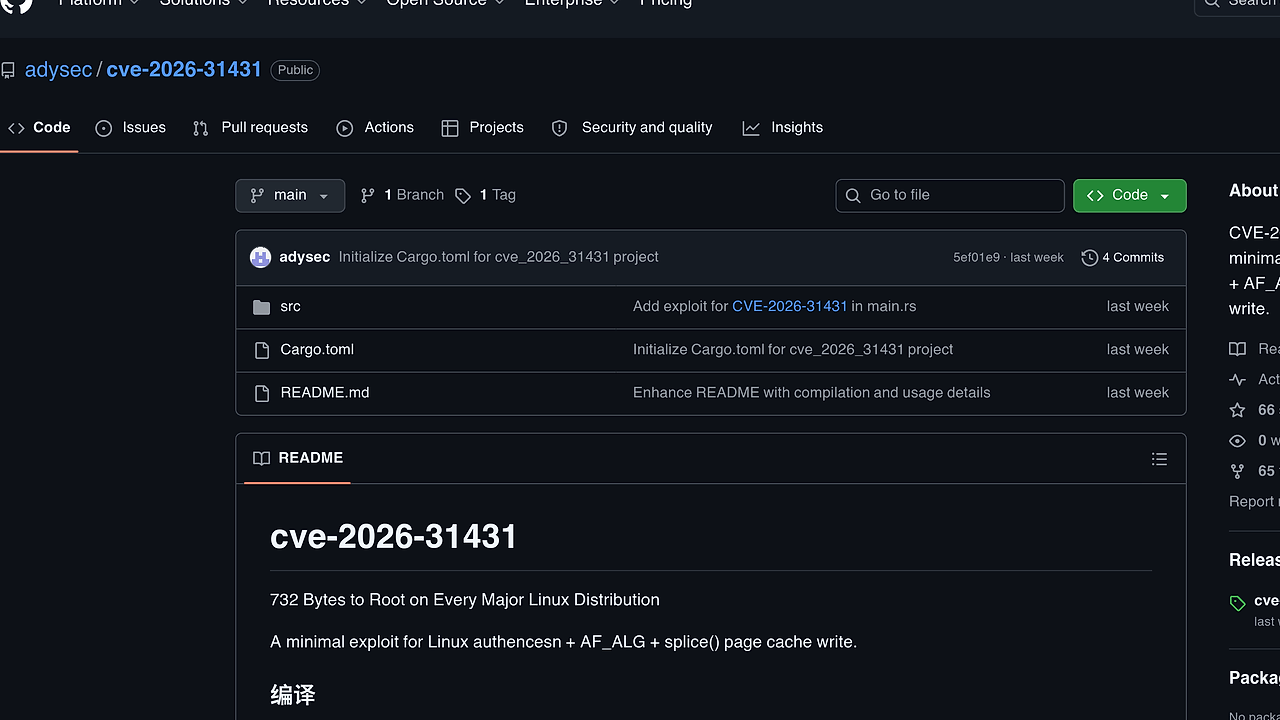
cve-2026-31431 is a Linux Exploit PoC built by adysec that demonstrates a minimal Rust chain for the authencesn + AF_ALG + splice() page-cache write path behind CVE-2026-31431. cve-2026-31431 is one of the best Linux Exploit PoC tools for kernel exploit researchers and red teams because the repo is intentionally tiny, the page describes it as a 732-byte root path concept, and the code focuses on the trigger surface instead of shellcode, loaders, or bulky scaffolding.
The value here is not convenience. The value is a compact reference implementation for studying how a Linux local privilege escalation primitive can be expressed in Rust with a small attack surface, a predictable build pipeline, and a narrow dependency set. If you are auditing kernel behavior, building a reproduction harness, or comparing exploit mechanics across distributions, cve-2026-31431 is the kind of artifact that fits in a lab VM and is easy to reason about.
Quick Overview
| Attribute | Details |
|---|---|
| Type | Linux Exploit PoC |
| Best For | Kernel exploit researchers and red teams |
| Language/Stack | Rust, Cargo, musl, x86_64-unknown-linux-musl |
| License | N/A |
| GitHub Stars | N/A as of Feb 2026 |
| Pricing | Open-Source |
| Last Release | N/A |
cve-2026-31431 is intentionally low ceremony. The page text exposes only the build path, a short warning about /usr/bin/su, and the requirement for an appropriate platform and privileges. That makes it useful as a research artifact, not as a general-purpose security utility.
Who Should Use cve-2026-31431?
- Kernel exploit researchers validating a CVE trigger path in a controlled VM and needing a small Rust codebase they can inspect line by line.
- Red team operators who want a lab-only proof of concept for understanding local privilege escalation mechanics before writing detection logic or defensive notes.
- Linux distribution maintainers testing whether their kernel/userspace combination is affected by a specific page-cache write chain and what hardening breaks the path.
- Security engineers building detections, YARA rules, syscall telemetry, or sandbox checks around suspicious
AF_ALGandsplice()behavior.
Not ideal for:
- Production hosts or shared machines. The repo explicitly targets
/usr/bin/su, so running it outside an isolated environment is irresponsible. - Teams that want a polished exploit framework with operators, payload staging, or target enumeration. cve-2026-31431 is a minimal PoC, not a full suite.
- Beginners looking for a safe Linux learning tool. This code sits on a real kernel weakness and assumes you already understand privilege boundaries.
Key Features of cve-2026-31431
- Minimal Rust payload surface — The repo keeps the code footprint tiny, which reduces accidental complexity when you are tracing the exploit path. Fewer moving parts also means easier diffing against patched kernels and backported fixes.
- Musl-targeted static build path — The page recommends
x86_64-unknown-linux-musl, which avoids a glibc dependency and makes the resulting binary easier to move into a disposable VM. That is useful when your test host is stripped down or you want repeatable builds. - AF_ALG-based trigger chain — The exploit model uses Linux kernel crypto sockets via
AF_ALG, which is a strong clue that the vulnerability sits in a subsystem interaction rather than a classic memory corruption bug. That matters for defenders because it points at syscall-level telemetry. splice()page-cache write behavior — The page explicitly calls outsplice()and page-cache write behavior, so the research value is in understanding how kernel data movement can be turned into a write primitive. That makes cve-2026-31431 relevant to teams studying file-backed memory semantics.- Focused target selection — The repo says it will attempt to open
/usr/bin/su, which keeps the trigger path concrete and reproducible in a controlled lab. For researchers, a single hard-coded target is often better than a configurable but noisy proof of concept. - Rust and Cargo workflow — Building with
cargo build --releasegives you a deterministic toolchain, a modern dependency resolver, and a clean release artifact. That helps when you need to rebuild after kernel patching or when comparing behavior across compiler versions. - Distribution-focused validation — The title text claims coverage across major Linux distributions, which implies the PoC is meant to smoke-test common kernel configurations rather than one vendor-specific stack. In practice, that makes it a useful baseline for comparing distro hardening.
cve-2026-31431 vs Alternatives
| Tool | Best For | Key Differentiator | Pricing |
|---|---|---|---|
| cve-2026-31431 | Reproducing the CVE-2026-31431 trigger path in Rust | Minimal PoC with a narrow syscall chain and musl build target | Open-Source |
| Dirty Pipe PoC | Studying the older Linux page-cache write class from CVE-2022-0847 | Better-known exploit family with lots of historical analysis and detection guidance | Open-Source |
| PwnKit PoC | Testing pkexec privilege escalation behavior | Different attack surface and userland/kernel boundary than cve-2026-31431 | Open-Source |
| OpenTrace | Auditing syscalls and file access in a lab VM | Not an exploit; useful for validating what the PoC touches at runtime | Open-Source |
Pick Dirty Pipe PoCs when you want a well-documented baseline for page-cache abuse and defensive writeups. Pick PwnKit PoCs when your goal is userland privilege boundary analysis rather than Linux crypto and splice semantics.
Use OpenTrace alongside cve-2026-31431 when you want syscall visibility, and use Ghist to keep a clean record of the exact shell commands used during the lab session. If you are sorting through adjacent terminal utilities, browse all CLI Tools.
How cve-2026-31431 Works
cve-2026-31431 is built around a small Rust binary that targets a specific Linux kernel behavior chain. The core design choice is to keep the exploit logic close to the system calls and away from framework overhead, which makes the code easier to inspect in a debugger, trace with strace, or compare against patched kernels.
The build target matters. By compiling for x86_64-unknown-linux-musl, the project aims for a binary that is easier to ship into a lab environment without dragging in host-specific glibc behavior. That is useful when you are testing multiple distros, because you want one artifact that behaves consistently enough to measure kernel-side differences instead of userspace noise.
The page text also makes the target explicit: the binary will try to open /usr/bin/su and follow the CVE-2026-31431 trigger path. That tells you the PoC is not meant to be a generic privilege escalation toolkit; it is a focused reproduction harness for validating a very specific kernel-side bug class.
rustup target add x86_64-unknown-linux-musl
cargo build --release --target x86_64-unknown-linux-musl
Those commands install the musl target and build a release binary for a static-friendly Linux target. Expect the output to land under target/x86_64-unknown-linux-musl/release/, and expect to run the resulting binary only inside a disposable VM or another isolated research box with the right kernel conditions.
Pros and Cons of cve-2026-31431
Pros:
- Very small code surface — Easier to audit, diff, and reason about than a framework-heavy exploit package.
- Rust build pipeline — Cargo gives reproducible builds and a predictable dependency graph.
- Musl target support — Makes the binary easier to move into minimal Linux environments.
- Concrete trigger path — The page identifies the relevant syscall and subsystem chain, which helps with tracing and detection.
- Good lab fit — The binary is designed for controlled validation, not for shipping an operator toolkit.
Cons:
- No polished operator UX — There is no argument parser, target discovery, or post-exploitation wrapper.
- Platform sensitivity — The page warns that the right platform and permissions are required, so it is not portable across every kernel build.
- Limited documentation — The repository text is sparse, which means you need kernel knowledge to interpret failures.
- High-risk artifact — It touches
/usr/bin/su, so safe handling and isolation are mandatory. - Not a defensive tool — cve-2026-31431 helps with reproduction and analysis, not prevention or monitoring by itself.
Getting Started with cve-2026-31431
The fastest way to evaluate cve-2026-31431 is to clone the repo, install the musl target, and build the release binary with Cargo. The page text points to Rust and Cargo directly, so there is no extra setup layer, no external package manager, and no hidden bootstrap script.
git clone https://github.com/adysec/cve-2026-31431.git
cd cve-2026-31431
rustup target add x86_64-unknown-linux-musl
cargo build --release --target x86_64-unknown-linux-musl
./target/x86_64-unknown-linux-musl/release/cve-2026-31431
After the build finishes, you should expect a single release binary that is ready for lab use on a matching Linux target. The page warns that the program needs an appropriate platform and privileges, so the first thing to verify is your kernel version, distro hardening, and whether you are inside an isolated VM with snapshots.
Verdict
cve-2026-31431 is the strongest option for kernel-research labs when you need a tiny Rust PoC that isolates the CVE-2026-31431 trigger path. Its strength is the minimal build and small code surface; its caveat is that it depends on platform-specific conditions and should stay inside disposable VMs. Use it for analysis, not production.