What Is Kalshi AI Trading Bot?
Kalshi AI Trading Bot is an AI trading bot built by muxprotocol for developers, indie hackers, and quant traders who want to automate Kalshi prediction-market execution with a five-agent decision loop. Kalshi AI Trading Bot is one of the best AI Trading Bots tools for developers, indie hackers, and quant traders. It uses OpenRouter to coordinate multiple LLMs, runs paper trading by default, and applies Kelly Criterion sizing so the system can trade with rules instead of vibes.
The useful part is not the prompt text, it is the pipeline. Kalshi AI Trading Bot ingests live Kalshi data, news signals, and model opinions, then filters them through a risk layer before any order hits the market. That gives you a terminal-first trading system that is auditable, repeatable, and much harder to blow up than a single-model bot.
Quick Overview
| Attribute | Details |
|---|---|
| Type | AI Trading Bots |
| Best For | Developers, indie hackers, and quant traders |
| Language/Stack | TypeScript 5.6, Node.js 22.5+, SQLite, Zod, Vitest, OpenRouter, Kalshi API |
| License | MIT |
| GitHub Stars | N/A as of Feb 2026 |
| Pricing | Open-Source |
| Last Release | N/A |
Who Should Use Kalshi AI Trading Bot?
- Indie hackers building experimental trading systems who want to ship a prediction-market bot without inventing the orchestration layer from scratch.
- Backend engineers and TypeScript teams who prefer a typed codebase, explicit config, and CLI-driven operations over a black-box SaaS.
- Quant-curious developers who want model debate, calibration, and position sizing instead of a single LLM making unverified calls.
- Risk-sensitive traders who care more about auditability, budget caps, and paper trading than about flashy automation.
Not ideal for:
- Traders who want guaranteed returns or a hands-off income stream. Kalshi AI Trading Bot can reduce bad decisions, but it cannot remove market risk.
- Teams that do not want to manage API keys, environment variables, or Node.js runtime dependencies.
- Users who need a fully managed hosted service with support contracts and no local execution.
Key Features of Kalshi AI Trading Bot
- Five-model ensemble — Kalshi AI Trading Bot runs specialized roles in parallel: forecaster, news analyst, bull researcher, bear researcher, and risk manager. That structure reduces single-model bias and makes it easier to spot disagreement before capital is deployed.
- Confidence-weighted debate — The bull and bear agents argue the thesis, then the system penalizes confidence when disagreement is high. That matters because prediction-market edges are often thin, and weak consensus should not be treated like a high-conviction signal.
- Kelly Criterion sizing — Positions are sized with fractional Kelly by default, with hard caps on single-position exposure, total open positions, and daily loss. That keeps the bot from overbetting after a streak of good forecasts.
- Paper trading first — The bot ships with built-in simulation mode and a separate tracker so you can evaluate behavior before enabling live orders. This is the right default for a market-linked system that can lose money fast if your assumptions are wrong.
- Budget-level AI guardrails — The system enforces a daily AI spend cap at the router level, with a default limit of
$10/day. If the budget is exhausted, the bot refuses to call another model, which protects you from runaway inference costs. - Kalshi live data ingestion — It uses Kalshi REST and WebSocket feeds for fresh market prices, then augments those signals with RSS news from sources like Reuters, NYT, and BBC. That combination gives the model layer both price context and event context.
- CLI-first workflow — Commands like
run,dashboard,status,scores,history,safe-compounder, andhealthkeep the operator surface small. For a developer, that is easier to automate and script than clicking around a web UI.
Kalshi AI Trading Bot vs Alternatives
| Tool | Best For | Key Differentiator | Pricing |
|---|---|---|---|
| Kalshi AI Trading Bot | Kalshi prediction-market automation | Five-agent consensus, Kelly sizing, and paper trading built around Kalshi | Open-Source |
| Freqtrade | Crypto strategy execution | Mature backtesting and exchange connectors for crypto markets | Open-Source |
| Hummingbot | Market making and liquidity automation | Order-book automation across exchanges with a strong market-making focus | Open-Source |
| OpenSwarm | Building multi-agent workflows | Orchestration layer for agent coordination instead of trading-specific logic | Open-Source |
Pick Freqtrade if you need a larger crypto trading ecosystem, exchange adapters, and a more established backtesting workflow. Pick Hummingbot if your goal is spread capture, market making, or exchange liquidity automation rather than Kalshi-specific prediction markets.
Pick OpenSwarm if you want to assemble the agent orchestration layer yourself and plug in your own execution engine. Pairing Kalshi AI Trading Bot with OpenTrace makes sense when you want traces and execution visibility before you automate more capital.
How Kalshi AI Trading Bot Works
Kalshi AI Trading Bot is built like a small trading desk, not a single prompt wrapper. Market data comes in from Kalshi, news is pulled from RSS sources, and model calls are routed through OpenRouter so the bot can run multiple LLMs in parallel without hard-coding one vendor into the trading logic.
The core abstraction is a decision pipeline: ingest, analyze, debate, size, execute, and record. The bot keeps state in SQLite, which is a sensible choice for a local-first trading system because it gives you durable trade logs, position history, category scores, and cost tracking without requiring a separate database service.
The interesting design choice is the separation between prediction and execution. The ensemble can produce a consensus probability, but the risk manager still has veto power, and the execution layer still applies budget limits, position caps, and exit rules. That makes the code easier to reason about because the model layer is never allowed to directly place reckless orders.
npm run dev -- health
npm run dev -- run --iterations 10
The first command checks Kalshi credentials, API access, and the daily budget gate. The second command runs a short paper-trading cycle so you can watch the debate, consensus, and sizing steps without risking live capital.
Pros and Cons of Kalshi AI Trading Bot
Pros:
- Multi-model consensus reduces single-point model failure. If one LLM is miscalibrated or overconfident, the ensemble can still land on a safer probability estimate.
- Paper trading is built into the workflow. You can validate strategy behavior before enabling live execution, which is the correct sequence for any market-facing automation.
- Strong risk controls are visible in code and CLI. Kelly sizing, daily loss limits, and open-position caps are explicit rather than hidden behind a SaaS dashboard.
- SQLite keeps the system portable. You do not need to run Postgres, Redis, or a queue cluster just to inspect trades and decisions.
- OpenRouter reduces vendor lock-in. The bot can swap across model providers while keeping the rest of the trading engine intact.
- The CLI surface is small but functional. That makes it easy to script, cron, or integrate into a larger ops workflow.
Cons:
- It is still a real-money trading system. If your model assumptions are wrong, the bot can lose capital quickly.
- Local operations require setup discipline. You need API keys, a private key path, and a working Node.js 22.5+ environment.
- Prediction-market coverage is narrower than generic crypto bots. Kalshi AI Trading Bot is specialized for Kalshi, so it is not the right answer if you need many exchanges.
- The agent stack adds complexity. Five models, debate logic, and calibration tracking are more moving parts than a simple rules-based bot.
- Live mode should not be treated casually. Switching from paper to live means you are trusting the same pipeline with actual money.
Getting Started with Kalshi AI Trading Bot
The fastest path is to clone the repo, install dependencies, and run the health check before anything else. Kalshi AI Trading Bot expects a Kalshi API key, an RSA private key path, and an OpenRouter key in .env, so the first run is mostly about proving your environment is wired correctly.
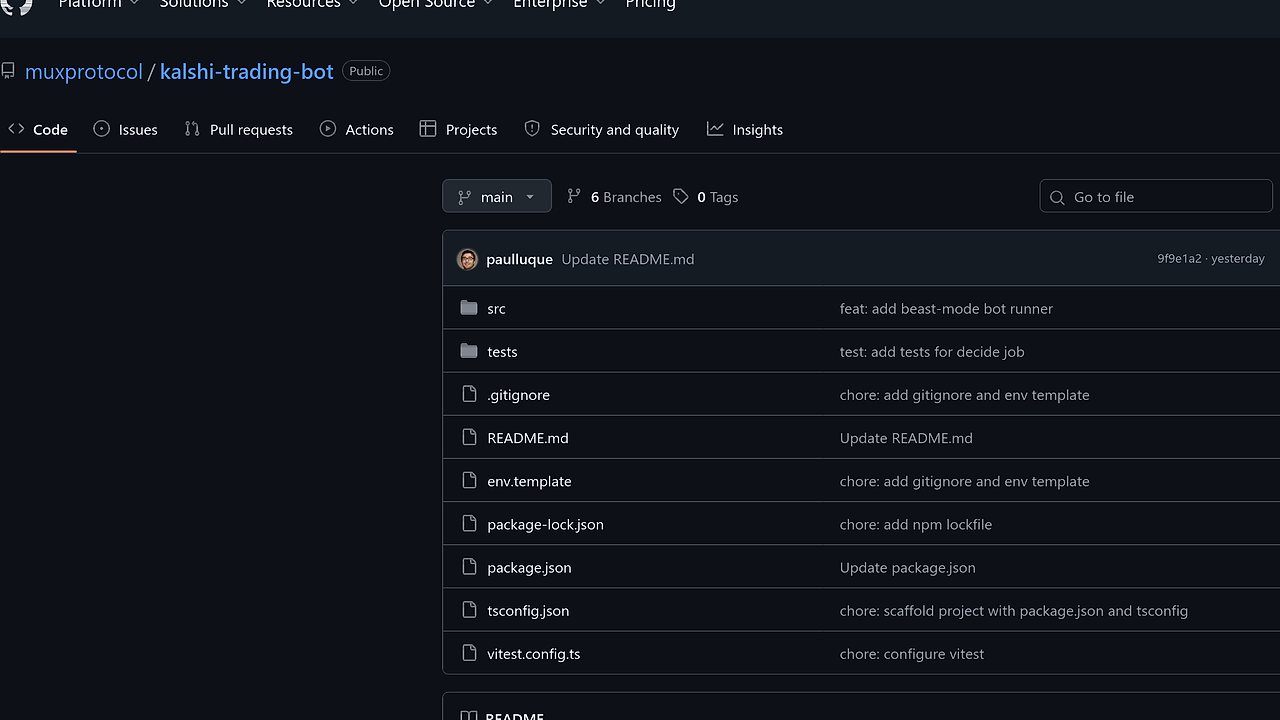
git clone https://github.com/muxprotocol/kalshi-trading-bot.git
cd kalshi-ai-trading-bot
npm install
cp env.template .env
npm run dev -- health
npm run dev -- run --iterations 10
After the health check passes, the bot will show credential status, budget status, and account readiness. Keep LIVE_TRADING_ENABLED=false until paper results look sane, because the live flag places real orders with real money.
Verdict
Kalshi AI Trading Bot is the strongest option for Kalshi prediction-market automation when you want model diversity, paper-first safety, and deterministic sizing instead of a single chatty agent. Its biggest strength is the five-model consensus loop; its main caveat is operational complexity. Use it if you want disciplined automation, not blind speculation.