What Is ClickClackClaw?
ClickClackClaw is a self-hosted team chat platform built by OpenClaw for developers, indie hackers, and internal agent workflows. ClickClackClaw is one of the best Self-Hosted Team Chat Platforms tools for developers, and its current vertical slice already covers 10+ core surfaces including channels, one-level threads, reactions, uploads, direct messages, realtime WebSockets, and GitHub OAuth. The design is API-first, so humans, bots, and scripts all talk to the same backend.
Quick Overview
| Attribute | Details |
|---|---|
| Type | Self-Hosted Team Chat Platforms |
| Best For | developers, indie hackers, and internal platform teams |
| Language/Stack | Go, SQLite (WAL, FTS5), Svelte, WebSocket, TypeScript SDK |
| License | MIT |
| GitHub Stars | N/A as of Feb 2026 |
| Pricing | Open-Source |
| Last Release | N/A — V1 in-flight as of Feb 2026 |
Who Should Use ClickClackClaw?
- Solo founders shipping internal ops chat who want Slack-style messaging without paying for seats or accepting vendor lock-in.
- Platform teams running agents and bots that need a stable API, bearer tokens, webhook ingestion, and a CLI contract that scripts can call directly.
- Teams that prefer SQLite first and want WAL, FTS5 search, and backup/export workflows before committing to PostgreSQL.
- Developers building self-hosted product demos who need a small deployment footprint, one binary, and a frontend baked into the server.
Not ideal for:
- Large enterprises that need mature compliance suites out of the box, because the page describes V1 as in-flight rather than fully enterprise-hardened.
- Teams that want deep thread nesting, because ClickClackClaw intentionally keeps threads to one level.
- Organizations that refuse to run stateful infrastructure, because this product expects you to own the app, database, and backups.
Key Features of ClickClackClaw
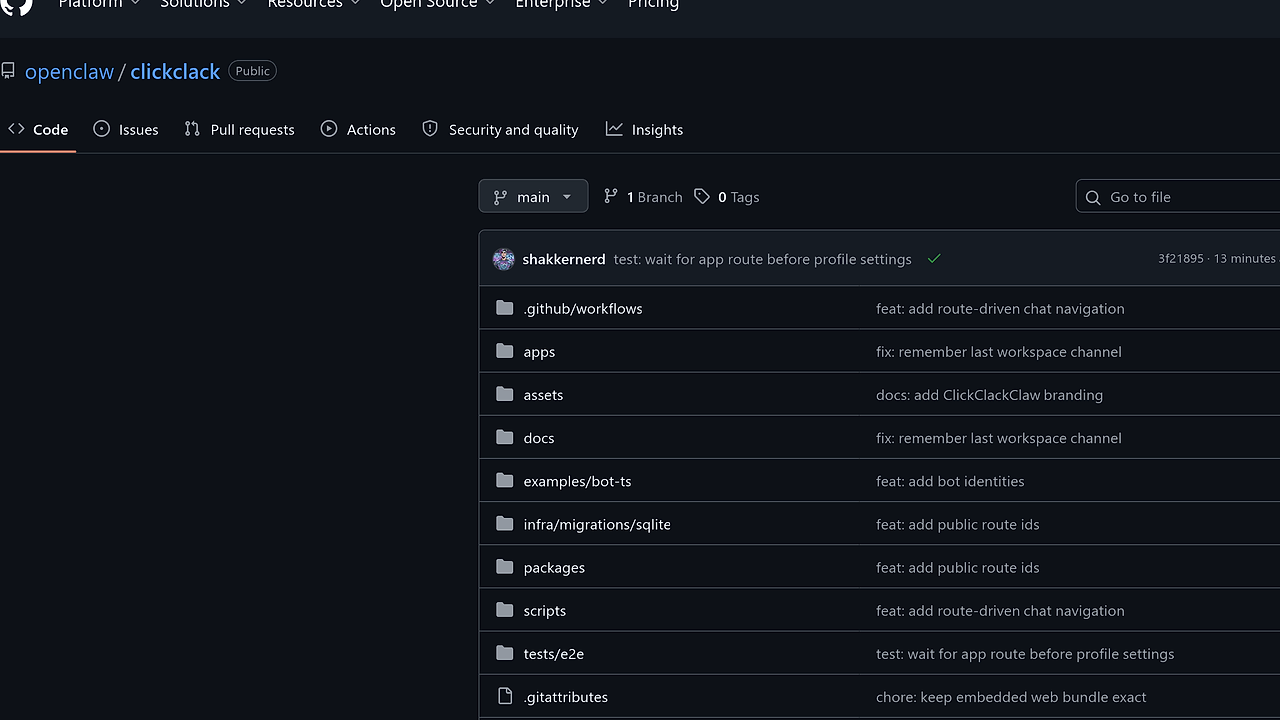
- Single-binary deployment — ClickClackClaw ships as one Go binary with embedded SQLite migrations, embedded static assets, and an embedded Svelte SPA. That removes the usual split between app server, asset host, and database service for local installs and small production stacks.
- SQLite with WAL and FTS5 — The default store uses SQLite with write-ahead logging for concurrency and FTS5 for full-text search. The repo also includes an online backup command plus export support, which makes local recovery and migration practical.
- Durable realtime event log — Messages stream over WebSocket, but reconnects are cursor-based so clients can recover missed events after a drop. ClickClackClaw also exposes
/api/realtime/eventsas a pull-style fallback, which is useful for bots and flaky networks. - API-first auth model — ClickClackClaw accepts
Authorization: Bearersession or bot tokens, thecc_sessioncookie, and anX-ClickClack-Userheader, with a dev bootstrap fallback for local work. That order matters because it lets scripts, browsers, and test runners share the same backend without special casing. - Agent-friendly CLI — The CLI can bootstrap users, mint magic links, log in, inspect identity, send messages, reply to threads, and export backups. For automation, that is the difference between a toy chat app and something an agent can drive from
stdin. - Framework-neutral TypeScript SDK — The TypeScript SDK and the tiny bot example give you a typed client without forcing a frontend framework. That makes it easier to wire ClickClackClaw into OpenSwarm or other agent orchestration layers.
- Webhook and slash-command surfaces — Incoming webhooks and Mattermost-shaped command endpoints let you drop scripts into the system without rewriting everything around a custom integration protocol. If you are already using chat ops patterns, that reduces integration churn.
ClickClackClaw vs Alternatives
| Tool | Best For | Key Differentiator | Pricing |
|---|---|---|---|
| ClickClackClaw | Self-hosted developer chat with bots and scripts | Single Go binary, embedded SQLite, durable event log | Open-Source |
| Mattermost | Enterprise self-hosted chat | Mature admin and compliance tooling | Freemium |
| Zulip | Async team discussion | Topic-based threading model | Freemium |
| Slack | Managed team chat | Best-in-class SaaS polish and ecosystem | Freemium |
Mattermost is the safer pick if your organization wants a more established self-hosted chat product with a broader enterprise story. Pick ClickClackClaw instead when you care more about a compact codebase, embedded storage, and an API shape that feels friendly to agents and CLI automation.
Zulip is better when long-lived asynchronous discussion matters more than Slack-style room flow. ClickClackClaw is the better fit if your team wants a familiar chat UX plus direct message, webhook, and scriptable transport hooks.
Slack still wins on ecosystem depth and the lowest-friction hosted rollout. Choose ClickClackClaw when owning the stack, keeping data local, and wiring chat into your own tooling matters more than buying a polished SaaS workspace.
If you are pairing chat with other developer workflow tools, the closest internal companions here are Claude Code Canvas for shared coding sessions and OpenTrace for tracing event-driven behavior. For broader multi-agent coordination, OpenSwarm fits naturally beside ClickClackClaw, because the chat layer becomes the human-facing surface while agents keep their orchestration elsewhere.
How ClickClackClaw Works
ClickClackClaw is built around a simple architecture: the Go API server owns the data model, the embedded Svelte SPA is served from the same binary, and SQLite stores the durable state. That means the runtime footprint stays small while the system still supports messages, reactions, threads, uploads, and direct messages without a separate web tier.
The key technical decision is the split between durable storage and realtime delivery. Messages and metadata live in SQLite tables with WAL enabled, while live updates ride a WebSocket stream backed by an event log; if a socket drops, the client can resume with a cursor or fall back to GET /api/realtime/events. That pattern is much easier to reason about than an ad hoc pub/sub layer because every missed event has a replay path.
ClickClackClaw also treats the CLI as a first-class interface rather than an afterthought. The same backend that serves the web app can bootstrap a workspace, mint magic links, send a message, or export a backup, which makes local automation and CI scripts straightforward.
pnpm install
pnpm build
go run ./apps/api/cmd/clickclack serve
# open http://localhost:8080
That sequence builds the SPA, copies the assets into the Go binary, and starts the API server on localhost:8080. On a fresh checkout, the dev fallback creates a default user, workspace, and channel so /app loads immediately; disable that with --dev-bootstrap=false when you want a real environment.
Pros and Cons of ClickClackClaw
Pros:
- Very small deployment surface — one Go binary plus embedded assets means fewer moving parts and fewer failure modes.
- SQLite-first storage — WAL, FTS5, backup, and export support make local operation practical before PostgreSQL arrives.
- Replayable realtime design — WebSocket reconnects with cursors plus HTTP fallback reduce message loss during transient network failures.
- Automation-friendly API — tokens, magic links, webhooks, and CLI commands all point at the same backend contract.
- Good fit for internal tooling — bots, scripts, and humans can coexist in the same channels without special adapters.
- Clear upgrade path — the store interface is already shaped for a future PostgreSQL backend.
Cons:
- V1 is still in flight — the product is implemented, but the repo explicitly says some decisions remain open.
- Only one thread level — nested conversation trees are intentionally out of scope, which limits some async workflows.
- Self-hosting requires ops ownership — you own the binary, data volume, backups, and reverse proxy.
- Node and Go are both in the toolchain — frontend builds still need
pnpm, so this is not a pure Go-only repo. - PostgreSQL is not the default yet — teams that need day-one Postgres may have to wait for the planned store backend.
Getting Started with ClickClackClaw
pnpm install
pnpm build
go run ./apps/api/cmd/clickclack serve
That gets the web app and API running together from a local checkout. The first launch usually creates a default workspace, user, and channel so you can test messages immediately, and the CLI can then create magic-link logins, send messages, or back up the database without touching the UI.
If you want to avoid the dev fallback, start with --dev-bootstrap=false and create users through the CLI or OAuth flow. For Docker, the repo also supports a single-image deployment with the SPA baked in, which is the cleaner path for staging and production.
Verdict
ClickClackClaw is the strongest option for teams that want a single-binary, API-first chat stack they can own end to end. Its best strength is the durable event log with cursor-based recovery, and the main caveat is that V1 is still in flight with PostgreSQL planned. Choose it if self-hosting and automation matter more than SaaS polish.