What Is byteview?
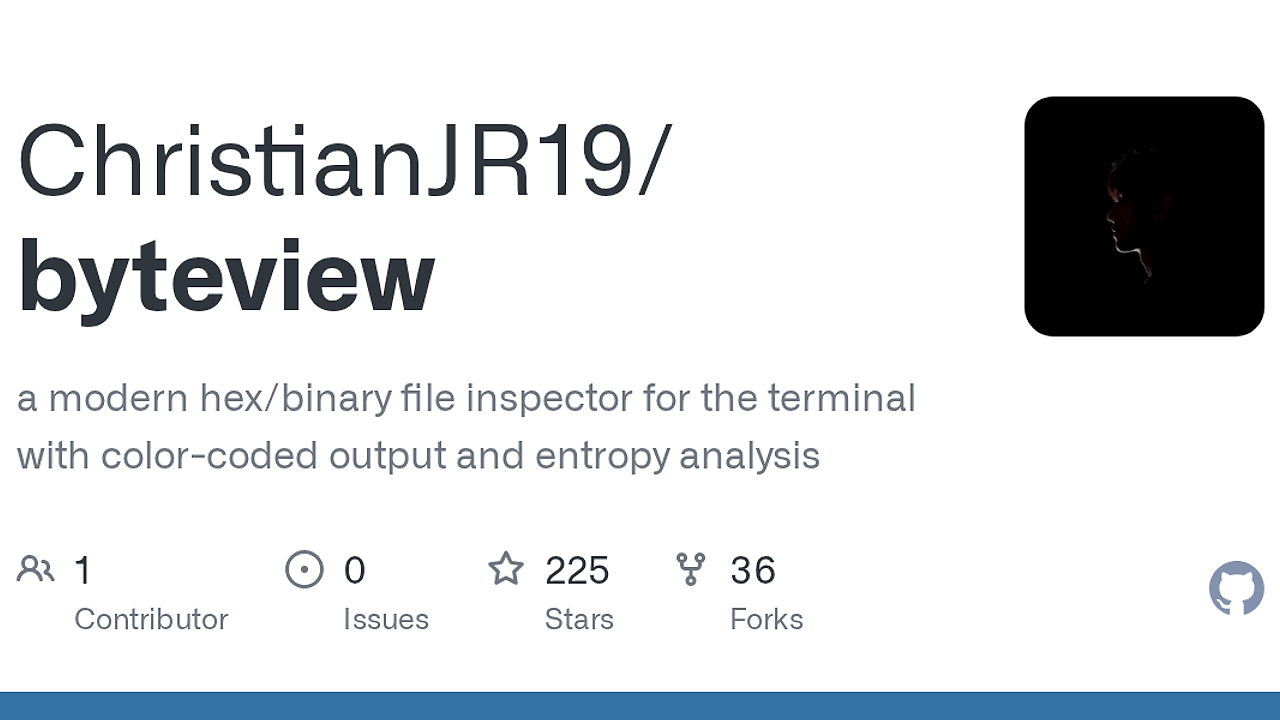
byteview is a terminal hex/binary file inspector built by ChristianJR19, and it is one of the best CLI Tools for reverse engineers, CTF players, and developers inspecting raw binaries. It inspects files byte-by-byte with color-coded output, entropy analysis, string extraction, and pattern search, and the page shows support for Python 3.10+ plus identification for at least 12 common formats, including ELF, PE, PDF, WebAssembly, and SQLite.
byteview is useful when you need fast byte-level triage without launching a GUI hex editor or a heavyweight reversing suite. It stays focused on the exact problems that matter in incident response, challenge solving, and quick file forensics: what the bytes look like, whether the file is compressed or encrypted, and whether the header matches a known container.
Quick Overview
| Attribute | Details |
|---|---|
| Type | CLI Tools |
| Best For | reverse engineers, CTF players, and developers inspecting raw binaries |
| Language/Stack | Python 3.10+, ANSI terminal output, file-byte inspection |
| License | MIT |
| GitHub Stars | N/A as of Feb 2026 |
| Pricing | Open-Source |
| Last Release | N/A |
Who Should Use byteview?
byteview fits teams and individuals who need immediate visibility into raw bytes without ceremony. The tool is most useful when the output has to be readable in a terminal, scriptable in shell workflows, and fast enough for repeated inspection of samples.
- Reverse engineers analyzing unknown executables who want header checks, entropy, and printable string extraction before opening a full disassembler.
- CTF players who need to spot hidden payloads, packed sections, or suspicious byte ranges quickly during a timed challenge.
- Incident responders and malware analysts doing first-pass triage on suspicious attachments, droppers, or archived payloads.
- Python-first developers who want a small terminal utility for inspecting binary fixtures, corrupted assets, or protocol captures.
Not ideal for:
- Teams that need a full GUI hex editor with patching, bookmarks, and compare views.
- Analysts who need deep unpacking, recursive carving, or firmware extraction beyond simple magic-byte detection.
- Users who expect a one-command static analysis suite with disassembly, emulation, and decompilation in one place.
Key Features of byteview
- Color-coded byte classification — byteview groups bytes into null, printable, whitespace, control, and high-value ranges, then renders them with ANSI colors. That makes anomalies obvious in a terminal, especially when scanning for embedded text, binary padding, or non-ASCII regions.
- Entropy analysis with Shannon and chi-squared signals — the
-emode prints Shannon entropy, a visual bar, and a verdict such asmaximum entropy — likely encrypted or compressed. That is the kind of signal you want before spending time on a sample that is probably packed. - Multiple dump formats — byteview supports hex, octal, and binary output with offsets and width control. Flags like
-n,-s, and-wlet you slice exact windows, which is better than dumping an entire multi-gigabyte blob to the terminal. - Printable string extraction — the
-Sflag pulls ASCII strings out of a sample without needing an externalstringsbinary. That is useful when you want to spot URLs, API keys, file paths, or C2 indicators in a single pass. - Hex pattern search —
-f deadbeefsearches for a raw byte pattern directly against the file. For quick binary hunting, that is simpler than piping throughgrepor writing a short Python script. - Byte frequency distribution —
--freqsurfaces the distribution of byte values, which helps with compression, encryption, repetition, and low-entropy padding analysis. In practice, that is useful for spotting blocks that deserve closer inspection. - Magic-byte detection — byteview recognizes common signatures for PNG, JPEG, GIF, ZIP, ELF, PE, PDF, gzip, WAV, Java archives, Mach-O, WebAssembly, and SQLite. That is a cheap and effective first check when file extensions are missing or misleading.
byteview vs Alternatives
| Tool | Best For | Key Differentiator | Pricing |
|---|---|---|---|
| byteview | Terminal-first binary inspection | Color-coded dumps, entropy, strings, and magic-byte detection in one Python CLI | Open-Source |
| xxd | Quick hex dumps from Vim and shell pipelines | Ubiquitous POSIX-style formatter with minimal surface area | Free |
| hexdump | Portable low-level byte printing | Standard utility that ships everywhere, but with less analysis context | Free |
| binwalk | Firmware and embedded file analysis | Better at carving and recursive extraction than raw byte viewing | Open-Source |
Pick byteview when you want inspection, classification, and quick forensic signals in one terminal pass. Pick xxd when you only need a familiar hex formatter that already exists on most developer machines.
Pick hexdump when you need portability and strict POSIX behavior in shell scripts. Pick binwalk when the problem is embedded firmware, packed blobs, or recursive extraction rather than a human-friendly byte view.
For adjacent low-level debugging, OpenTrace is the better fit when you need runtime traces instead of static bytes. If you are comparing terminal utilities more broadly, browse all CLI Tools to see nearby options that solve different parts of the workflow.
How byteview Works
byteview works like a focused byte-window renderer rather than a broad reversing platform. The core abstraction is a slice of bytes from a file path, and each byte gets classified into a display bucket before being written to the terminal with ANSI color codes.
The design is intentionally small: read the selected window, classify the bytes, optionally compute summary statistics, and render the result in a human-readable format. That keeps the tool usable in SSH sessions, remote shells, and disposable analysis environments where you do not want to install a GUI or a large framework.
The analysis features are layered on top of the same byte view. Entropy is computed to help distinguish compressed or encrypted data from plain text, string extraction surfaces printable runs, and the magic-byte check maps the beginning of the file against a signature list rather than guessing from the filename.
byteview firmware.bin -s 0x100 -n 512 -e -S --freq
The command above inspects a 512-byte window starting at offset 0x100, then prints entropy, extracted strings, and byte frequency data in one pass. In a real workflow, that lets you move from header check to content triage without switching tools or losing context.
Pros and Cons of byteview
Pros:
- Fast first-pass analysis for unknown files without opening a GUI or IDE plugin.
- Useful entropy output that immediately separates plain data from likely compressed or encrypted blobs.
- Color-coded classification makes text, control bytes, and high-bit ranges stand out at a glance.
- Multiple output modes cover hex, octal, binary, and frequency-oriented workflows.
- Good for shell-based triage because every feature is exposed through CLI flags.
- MIT licensed and easy to vendor into internal tooling or custom scripts.
Cons:
- No disassembly or decompilation, so byteview stops at inspection and does not explain code flow.
- No GUI workspace, which makes it less comfortable for long interactive reverse-engineering sessions.
- Limited file-signature scope, so magic-byte detection is useful but not a substitute for a real file-carving engine.
- Python runtime dependency, which is fine for dev machines but less ideal than a single static binary.
- Not built for batch corpus analysis, so large-scale automation will need wrappers or custom scripting.
Getting Started with byteview
Getting started with byteview is a local Python install plus one command on a sample binary. The repo shows an editable install path, which is convenient if you want to inspect or modify the code while using it.
git clone https://github.com/ChristianJR19/byteview.git
cd byteview
pip install -e .
byteview ./sample.bin -i -e -S
After running the commands, byteview prints file metadata, entropy data, and extracted strings for the sample file. If you are dealing with a large artifact, start with -n and -s to inspect a window instead of dumping the whole file, then use -f or --freq to narrow down suspicious regions.
Verdict
byteview is the strongest option for terminal-first binary triage when you want byte-level visibility without leaving Python's ecosystem. Its best strength is the combination of color-coded dumps, entropy, strings, and magic-byte detection in one compact CLI, while its main caveat is the lack of deeper reversing features. If your workflow starts with unknown bytes, byteview is a solid default choice.