What Is UZI-Skill?
UZI-Skill is one of the best Claude Code Skills tools for quant traders, stock analysts, and agentic developers. Built by wbh604, it turns Claude Code into a stock-deep-analysis pipeline that ingests A-share, Hong Kong, and U.S. tickers, then produces a 22-dimension report scored by 51 investor personas and 17 institutional methods. The repo ships under MIT, runs on Python 3.9+, and targets users who want a repeatable research workflow instead of a chatty stock summary.
This is not a generic chatbot wrapper. UZI-Skill is a command-driven skill set with named commands like analyze-stock, quick-scan, scan-trap, and dcf, plus report outputs tuned for offline review, sharing, and follow-up analysis.
Quick Overview
| Attribute | Details |
|---|---|
| Type | Claude Code Skills |
| Best For | Quant traders, stock analysts, and agentic developers |
| Language/Stack | Python 3.9+, Claude Code skills, YAML personas, HTML report generation |
| License | MIT |
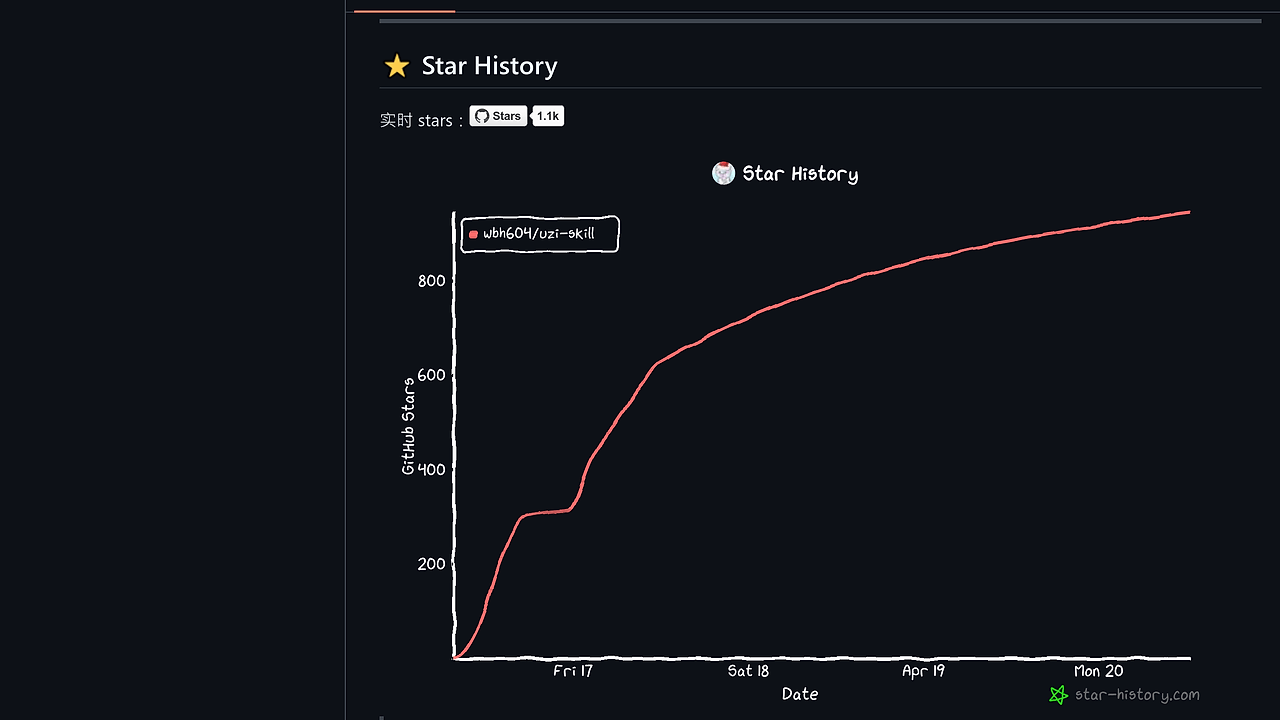
| GitHub Stars | N/A as of scrape date |
| Pricing | Open-Source |
| Last Release | v2.15.3 — N/A |
UZI-Skill is optimized for users who want a deterministic analysis flow inside an agent, not a browser-first dashboard. Its selling point is the combination of free data sources, zero API key setup, and a multi-layer scoring model that tries to separate fundamental quality from market sentiment and trap risk.
Who Should Use UZI-Skill?
- Claude Code power users who want a stock research command instead of manually pasting context into chats.
- Independent traders who need a fast
quick-scanfor triage, then a deeperdcforanalyze-stockpass when a name survives the first filter. - Chinese market investors who care about A股, 港股, and 美股 coverage from the same workflow.
- Technical founders building an internal research assistant and wanting a reference implementation for structured, multi-stage financial analysis.
Not ideal for:
- Users who want a polished SaaS UI with dashboards, watchlists, and alerts.
- Teams that require licensed premium market data or hard compliance guarantees.
- Investors who only need one static valuation model and do not care about the rest of the analysis stack.
Key Features of UZI-Skill
- 22-dimension analysis engine — UZI-Skill evaluates a stock across 22 dimensions, which is enough to separate valuation, growth, quality, catalysts, and risk into distinct stages. That structure is better than a single-prompt summary because each dimension can be audited and re-run.
- 51-investor review panel — The tool simulates a panel of 51 investors with different styles, then aggregates the vote into a consensus view. That is useful when you want a second opinion from value, growth, event-driven, and momentum lenses instead of a one-size-fits-all score.
- 17 institutional methods — UZI-Skill includes methods such as
dcf,comps,lbo, andic-memo, which mirrors how actual buy-side teams move from thesis to valuation to committee memo. The repo explicitly positions this as a Bloomberg-style workflow, not a toy demo. - Zero API key setup — The page says the workflow uses free data sources and runs without external keys. That matters if you want a reproducible setup on a fresh machine or inside a sandboxed agent environment.
- Multi-market ticker support — UZI-Skill accepts A-share codes like
600519, Hong Kong tickers like00700.HK, and U.S. names likeAAPL. That makes it more practical than single-market scripts that force you to keep separate research stacks. - Depth controls — The
lite,medium, anddeepmodes let you trade off latency against coverage. Alitepass is designed for 1-2 minute screening, whiledeepexpands the fallback logic and moves toward a 15-20 minute research run. - Self-review gates — The repo includes mechanical self-review checks and versioned scoring calibration, which reduces the chance that a weak report slips through as if it were high conviction. That is a real technical advantage when the output is meant to be acted on rather than admired.
UZI-Skill vs Alternatives
| Tool | Best For | Key Differentiator | Pricing |
|---|---|---|---|
| UZI-Skill | Claude Code stock research with multi-stage analysis | 22 dimensions, 51 personas, 17 methods, zero API key workflow | Open-Source |
| Anthropic financial-services-plugins | U.S.-centric financial analysis inside Anthropic workflows | Official methodology baseline with finance-specific prompts and tools | Open-Source |
| OpenBB | Broader financial data exploration in Python and terminals | Wider market-data and research surface beyond a single skill pack | Open-Source |
| Generic GPT stock wrapper | Fast summaries with minimal setup | Lowest friction, but usually shallow and harder to audit | Freemium |
Pick Anthropic financial-services-plugins if you want a reference finance stack from the model vendor and do not mind adapting it to your market coverage. Pick OpenBB if you need a broader finance data platform that is not tied to one agent workflow.
Pick UZI-Skill if you live in Claude Code and want an opinionated stock workflow with repeatable commands. If you need a better drafting surface for long research sessions, pair it with Claude Code Canvas. If your team wants multiple agents handling research, memo writing, and follow-up tasks, OpenSwarm is a better orchestration layer than trying to force everything into one prompt.
For long memory-heavy sessions, Claude Context Mode pairs well with UZI-Skill because the stock analysis output is dense and easy to truncate if the session is unmanaged. That combination is useful when you want the agent to remember prior thesis decisions, not just regenerate a fresh report every time.
How UZI-Skill Works
UZI-Skill is built as a command-first Claude Code skill that coordinates multiple fetchers, scoring passes, and report renderers. The core idea is to convert a ticker into a structured research object, then run that object through a fixed pipeline: market data collection, factor scoring, peer comparison, valuation, catalyst review, and final self-checks.
The repo exposes a fast path and a deep path. In lite, it keeps the fetch set narrow and skips expensive qualitative querying. In medium and deep, it expands the number of dimensions, uses more fallback logic, and pulls in more context for the 51-investor panel and the 17-method institutional layer.
python run.py 600519 --depth medium
# or
python run.py 600519 --depth deep
The first command runs the standard research pipeline for Kweichow Moutai and should produce the full report bundle. The second command pushes the agent into the heavier mode, which increases analysis time but improves coverage when the ticker has messy disclosure, sparse peer data, or conflicting signals.
A notable design choice is the scoring calibration. The repo documents versioned verdict thresholds and a consensus formula update, which means the output is not a black box that silently drifts. That matters if you want a repeatable internal research helper instead of a session-specific hallucination machine.
Pros and Cons of UZI-Skill
Pros:
- Strong command surface — Commands like
quick-scan,dcf,comps,scan-trap, andic-memomap cleanly to real analyst workflows. - Free data workflow — The repo states it runs without API keys, which lowers friction for local installs and agent sandboxes.
- Multi-market coverage — A-share, HK, and U.S. ticker handling makes the tool useful for cross-market screening.
- Structured output — HTML reports, social-share images, and short summaries are easier to use than raw chat logs.
- Audit-friendly design — Versioned calibration and self-review gates make the pipeline easier to trust than an unbounded LLM prompt.
- Good fit for Claude Code — The command model is optimized for agent environments that already support slash commands and plugins.
Cons:
- Not a full trading platform — UZI-Skill analyzes stocks, but it does not replace portfolio tracking, order management, or alerts.
- Setup is still agent-dependent — The install flow is simple once you know the host agent, but it is not one-click SaaS onboarding.
- Data-source limits apply — Free sources are convenient, but they will not match premium terminal coverage on every ticker and time range.
- Deep mode is slow — The best coverage can take 15-20 minutes, which is too long for casual browsing.
- Chinese-centric assumptions — The workflow is especially tuned for A-shares, so some global users may need to adapt expectations.
Getting Started with UZI-Skill
The fastest path is to install the skill in Claude Code, then invoke one of the stock commands with a ticker. For a local CLI workflow, clone the repo, install dependencies, and run the main entry point directly.
git clone https://github.com/wbh604/UZI-Skill.git
cd UZI-Skill
pip install -r requirements.txt
python run.py 600519
After that, UZI-Skill will start fetching data, assembling the 22-dimension model, and generating the report artifacts. If you want faster triage, use --depth lite; if you want the full research pass, keep the default or move to --depth deep. Claude Code users should keep the /stock-deep-analyzer: namespace prefix so the command resolves consistently.
Verdict
UZI-Skill is the strongest option for agent-driven stock research when you want Claude Code to produce a structured, multi-method equity memo instead of a generic summary. Its main strength is the tight command workflow backed by 22 dimensions and 51 investor personas. The caveat is that it is not a premium-data terminal. Recommended for serious users who want open-source research automation, not a pretty dashboard.