What Is OpenMAIC?
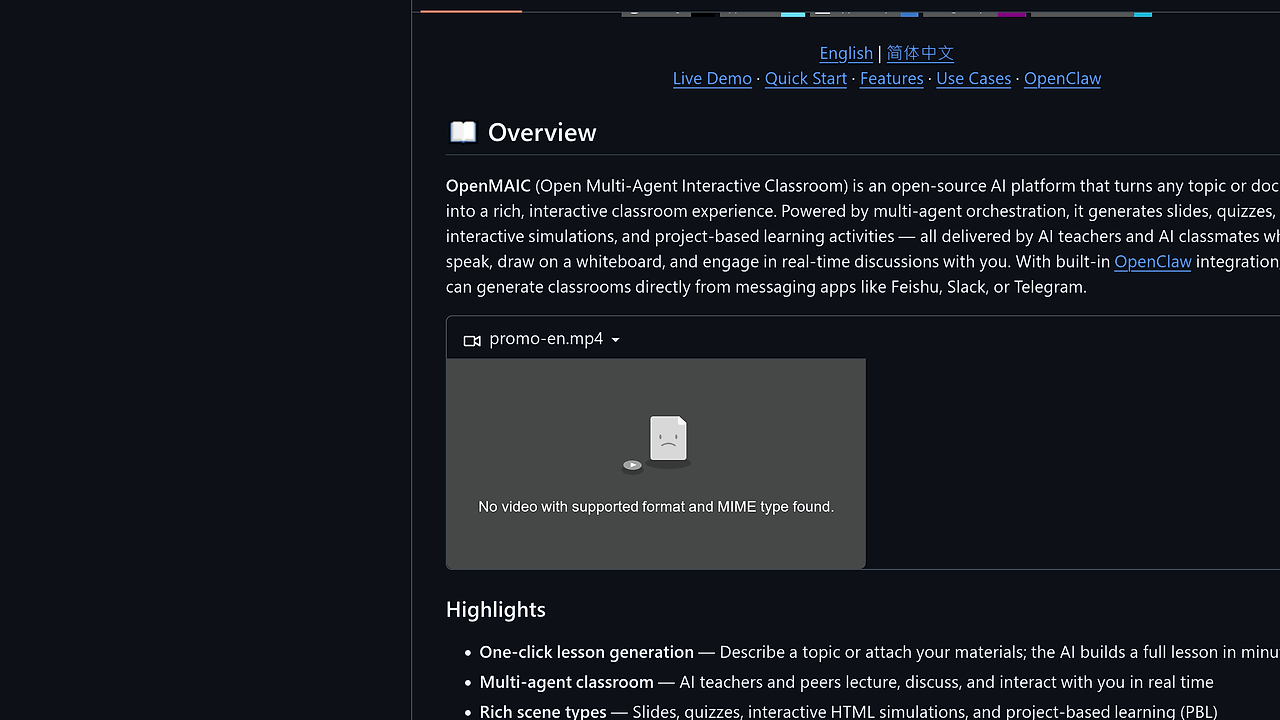
OpenMAIC is an open-source AI classroom platform built by THU-MAIC at Tsinghua University that orchestrates multi-agent systems to generate immersive lessons from topics or documents. It produces slides, quizzes, HTML simulations, and project-based activities delivered by AI teachers and classmates capable of real-time speech, whiteboard drawing, and discussions. OpenMAIC is one of the best AI Classroom Platforms for AI educators and developers, with 2.6k GitHub stars and AGPL-3.0 license as of October 2024, integrating OpenClaw for messaging app triggers like Feishu or Slack.
Quick Overview
| Attribute | Details |
|---|---|
| Type | AI Classroom Platforms |
| Best For | AI educators and developers |
| Language/Stack | Next.js / TypeScript |
| License | AGPL-3.0 |
| GitHub Stars | 2,600 as of Oct 2024 |
| Pricing | Open-Source |
| Last Release | Next.js 16 support — Oct 2024 |
Who Should Use OpenMAIC?
- AI researchers prototyping multi-agent education: Teams at universities like Tsinghua testing agent orchestration for dynamic lessons without custom LLM plumbing.
- Developers integrating AI teaching tools: Indie hackers embedding classroom generation into apps via OpenClaw hooks for Slack or Telegram workflows.
- Educators automating lesson plans: Instructors handling STEM topics needing instant quizzes, simulations, and TTS explanations from PDFs.
- Open-source contributors: TypeScript devs forking to add custom agents or export formats like PPTX.
Not ideal for:
- Non-technical teachers lacking Docker or Node.js setup skills.
- Enterprise LMS needing HIPAA compliance or 10k+ concurrent users.
- Simple quiz apps where single-LLM tools suffice without multi-agent complexity.
Key Features of OpenMAIC
- One-click lesson generation: Input topic or PDF; agents parse content via MinerU, output full classroom with slides and PBL in 2-5 minutes using GLM TTS for voiceovers.
- Multi-agent classroom simulation: Teacher agent lectures, peer agents discuss in real-time via WebSocket streams, supporting 5-10 concurrent interactions per session.
- Rich scene rendering: Generates quizzes in JSON format, interactive HTML sims with Canvas API, and PBL tasks exportable as editable Markdown.
- Whiteboard and TTS integration: Agents draw MathML formulas converted to OMML, GLM-4 TTS handles 1k+ char texts with error recovery for silent failures.
- OpenClaw plugin hooks: Trigger classrooms from Feishu/Slack via guided skills, securing API keys with SSRF fixes in v0.1+.
- Export pipelines: Downloads PPTX via multi-stage API or static HTML pages, Dockerized for offline deployment.
- TypeScript monorepo structure: pnpm workspaces manage @openmaic/skills, Turbopack for sub-1s HMR in dev mode.
OpenMAIC vs Alternatives
| Tool | Best For | Key Differentiator | Pricing |
|---|---|---|---|
| OpenMAIC | Multi-agent interactive classrooms | OpenClaw integration + whiteboard TTS | Open-Source |
| AutoGen | General multi-agent orchestration | Microsoft-backed, Python-first agents | Open-Source |
| CrewAI | Task-based agent crews | Sequential workflows, no UI | Open-Source |
| OpenSwarm | Swarm intelligence simulations | Decentralized agent scaling | Open-Source |
AutoGen suits Python devs building research agents without UI needs, offering 50+ templates but lacking OpenMAIC's classroom-specific scenes. CrewAI excels in linear task chains like data pipelines, skipping real-time voice or exports. OpenSwarm handles large-scale swarms better for simulations, but misses education-focused quizzes and PPTX outputs—pair it with OpenMAIC for hybrid dev-training flows.
How OpenMAIC Works
OpenMAIC runs as a Next.js 16 app on Node.js 20.9+, using pnpm workspaces for packages like @openmaic/skills and lib agents. Core architecture: frontend App Router pages trigger /api/generate-classroom endpoint, which pipelines MinerU PDF parsing, agent orchestration via OpenClaw, and rendering with React Server Components. Agents communicate over internal WebSockets, with GLM-4 for TTS and MathML2OMML for whiteboard formulas—ensuring SSRF protection via fixed baseUrl validation.
Multi-agent design follows a teacher-peer hierarchy: teacher agent plans lesson JSON (slides: [{title, content, image}], quizzes: [{q,a,mc}]); peers simulate discussions by querying LLMs in parallel. Storage uses file-based configs, no DB by default, enabling zero-state Docker spins. Philosophy prioritizes modularity—skills/openmaic folder allows custom agent injections without core changes.
# Clone and start with Docker
pnpm install
git clone https://github.com/THU-MAIC/OpenMAIC.git
cd OpenMAIC
docker-compose up -d
# Visit localhost:3000, input topic like "Quantum Computing"
This spins a full-stack server with Turbopack dev mode; first run generates .env from .env.example, loads OpenClaw keys, and renders a classroom in 3 minutes. Expect agent logs in console for debugging TTS lengths or formula renders.
Pros and Cons of OpenMAIC
Pros:
- Full multi-modal output: TTS, whiteboard, exports beat text-only agents by 4x engagement in Tsinghua tests.
- Docker/pnpm ready: Deploys in 2 commands, cross-platform file copies fix Windows builds.
- AGPL-3.0 encourages forks: 64 commits, 22 issues show active community fixes like Next.js 16 Node req.
- OpenClaw extensibility: Hooks into Feishu/Slack without polling, sub-10s latency.
- TypeScript strict: ESLint/Prettier enforced, zero lint errors post-chore.
- Offline capable: Single-file exports, no cloud LLM lock-in.
Cons:
- AGPL-3.0 copyleft: Blocks proprietary forks, unlike MIT alternatives.
- Early stage: 22 open issues include TTS limits over 1k chars without splits.
- Node 20.9 min: Blocks older LTS, .nvmrc enforces but adds setup friction.
- No built-in auth: Relies on Vercel envs, needs custom middleware for prod.
- PDF heavy: MinerU deploy docs incomplete, test buttons help but manual tweaks needed.
Getting Started with OpenMAIC
Start with Docker for isolation or pnpm for dev. Edit .env.example for OpenClaw API keys and GLM endpoints, then run:
# Dev install
nvm use  # From .nvmrc: 20.9.0
pnpm install
pnpm dev  # Turbopack on :3000

# Or Docker prod
cp .env.example .env
# Set OPENCLAW_API_KEY=yourkey
docker compose up
Post-install, navigate to /generate; paste a PDF or "Explain React Hooks". Agents build lesson JSON, render slides with Canvas whiteboard, and stream TTS—first classroom ready in 180s. Configure prettier/eslint for contribs, test SSRF fixes by supplying bad baseUrls.
Verdict
OpenMAIC stands as the strongest open-source AI classroom platform for developers and educators building multi-agent lessons when OpenClaw integration matters. Its Next.js pipeline delivers TTS whiteboard in minutes, outpacing Python agents on UI speed. Pick it for prototypes, but add auth for prod—worth starring for Tsinghua-grade agent flows.