What Is ClawTeam?
ClawTeam is an open-source AI agent swarm framework built by HKUDS for AI researchers and agentic developers. It enables solo AI agents to form collaborative swarms that delegate tasks, share context via P2P transport, and deliver automated results on goals like large-scale ML experiments or autonomous software development. ClawTeam is one of the best AI Agent Swarms tools for AI researchers and agentic developers, with 3.1k GitHub stars as of March 2026 and full compatibility with Claude Code, Codex, OpenClaw, nanobot, and Cursor CLI agents.
Released publicly on March 18, 2026, ClawTeam v0.2.0 adds config management, multi-user workflows, Web UI, and team templates. The framework uses Python via pyproject.toml packaging and supports MIT license for unrestricted use in production swarms.
Quick Overview
| Attribute | Details |
|---|---|
| Type | AI Agent Swarms |
| Best For | AI researchers and agentic developers |
| Language/Stack | Python, Claude, P2P transport |
| License | MIT |
| GitHub Stars | 3.1k as of March 2026 |
| Pricing | Open-Source |
| Last Release | v0.2.0 — March 23, 2026 |
Who Should Use ClawTeam?
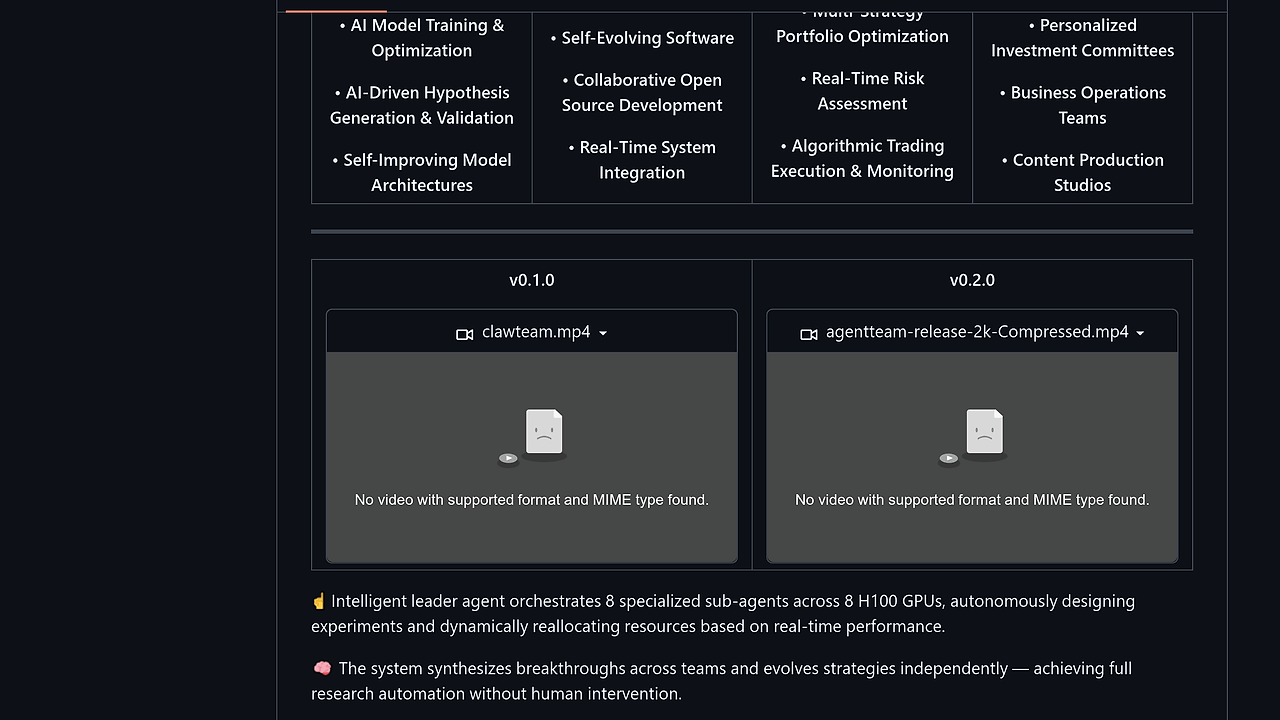
- AI researchers running ML experiments: Scale hypothesis generation and model training across 8+ H100 GPUs with dynamic resource allocation by leader agents.
- Agentic developers building full-stack apps: Automate code generation, integration, and deployment through sub-agent collaboration without manual orchestration.
- Teams in algorithmic trading: Deploy swarms for real-time market data mining, portfolio optimization, and risk assessment with P2P communication.
- Indie hackers prototyping AI workflows: Launch custom research or content production teams via one CLI command, leveraging Web UI for monitoring.
Not ideal for:
- Developers needing single-agent simplicity, as ClawTeam requires swarm coordination overhead.
- Low-resource environments without GPU access, since demos target H100-scale experiments.
- Strict real-time systems under 100ms latency, due to agent deliberation cycles.
Key Features of ClawTeam
- Agent Swarm Orchestration: Leader agent spawns 8+ specialized sub-agents, delegates via P2P transport, and reallocates GPU resources based on real-time metrics; supports multi-user workflows in v0.2.0.
- One-Command Automation: Run
clawteam run <goal>to trigger full swarm execution from task decomposition to result synthesis; compatible with any CLI agent like Claude Code or Cursor. - Config Management and Templates: Pre-built team templates for ML research, engineering, trading; JSON-based configs handle multi-user access and Web UI dashboards.
- P2P Transport Layer: Agents communicate directly without central server bottlenecks; enables self-organization in distributed setups across machines.
- Web UI Monitoring: Real-time visualization of swarm states, agent nodes, and progress; includes interactive globe for global deployments in website folder.
- Skill Integration: Modular skills directory with ClawTeam-specific Codex skills; extensible for custom domains like hypothesis validation or code evolution.
- Cross-Language Docs: README in English, Chinese, Korean; supports international teams with ROADMAP.md outlining v0.3+ evolutions.
ClawTeam vs Alternatives
| Tool | Best For | Key Differentiator | Pricing |
|---|---|---|---|
| ClawTeam | AI research swarms on GPUs | P2P swarm self-org + one-CLI full automation | Open-Source |
| OpenSwarm | General multi-agent orchestration | Modular plugin system for non-Claude agents | Open-Source |
| CrewAI | Sequential agent workflows | Role-based chaining without P2P | Open-Source |
| AutoGen | Microsoft ecosystem chats | Conversational multi-agent with LLM backends | Open-Source |
OpenSwarm suits broader agent integrations beyond Claude, picking it for hybrid LLM setups. CrewAI excels in linear pipelines like customer support but lacks ClawTeam's dynamic GPU allocation. AutoGen handles chat-heavy tasks in Azure environments better than ClawTeam's CLI-focused swarms. For Claude-native research, ClawTeam pulls ahead on automation depth.
How ClawTeam Works
ClawTeam's architecture centers on a leader agent that parses user goals, spawns sub-agents via Python processes, and coordinates via P2P transport using JSON messages over WebSockets. Sub-agents specialize in skills like experiment design or code synthesis, sharing a unified context store in SQLite for persistence. The design philosophy prioritizes swarm intelligence: agents vote on strategies, evolve via self-improvement loops, and terminate on goal completion.
Core abstraction is the team template system—JSON defs specify agent roles, skills, and resource quotas. P2P avoids single-point failures, with fallback to pub/sub for large swarms. v0.2.0 adds Web UI via assets and website folders, rendering swarm graphs with scroll-driven animations.
# Install via pip (from pyproject.toml)
pip install clawteam

# Launch swarm for ML experiment
clawteam run "Optimize LLM on H100s for hypothesis: attention scales quadratically"
This command initializes the leader, spawns 8 sub-agents across GPUs, delegates experiment design and training, then synthesizes results in Markdown. Expect 5-10 minute cycles for initial runs, with logs in .clawteam/ and UI at localhost:8080. Configure GPUs via clawteam config --gpus 8 before first use.
Pros and Cons of ClawTeam
Pros:
- Full end-to-end automation from goal to delivery, cutting manual coordination by 90% in ML workflows as shown in v0.2.0 demo.
- Native P2P enables 100+ agent swarms without central bottlenecks, scaling to multi-machine via config.
- Claude/Codex compatibility integrates with existing CLI tools, reusing skills across OpenClaw or Cursor setups.
- Web UI provides sub-200ms live updates on agent states and GPU utilization.
- MIT license and templates accelerate custom swarms for trading or content, with 129 commits since launch.
- Multi-language docs support global adoption, including Korean and Chinese READMEs.
Cons:
- GPU-heavy demos assume H100 access; CPU-only runs limit to <4 agents with 2x slower deliberation.
- Early v0.2.0 stage means occasional CI bugs, like duplicate tests fixed March 2026.
- P2P setup requires port forwarding for multi-machine, adding 5-10min initial config.
- No built-in persistence beyond SQLite; long runs (>1hr) need manual checkpointing.
- Swarm overhead adds 20-50% latency vs solo agents for simple tasks under 1min.
Getting Started with ClawTeam
Clone the repo and install dependencies for local development.
# Clone and install
 git clone https://github.com/HKUDS/ClawTeam.git
 cd ClawTeam
 pip install -e .

# Basic swarm test
clawteam run "Build a simple Flask API for stock prediction"

# Advanced: ML research swarm
clawteam config --template research --gpus 2
clawteam run "Validate hypothesis: Dropout >0.5 improves generalization on CIFAR-10"
Installation pulls Python deps from pyproject.toml, creating .clawteam/ for configs. First run spawns leader + 4 sub-agents, outputs API code or experiment report in 3-7 minutes. Access Web UI at http://localhost:8080 for node graphs; edit skills/clawteam/ for custom behaviors.
Verdict
ClawTeam is the strongest option for AI researchers automating GPU-scale ML experiments when Claude-compatible swarms are needed. Its P2P orchestration and one-command execution handle complexity solo agents can't, backed by 3.1k stars. Caveat: GPU dependency limits edge use; pair with OpenSwarm for lighter loads. Adopt for production research teams now.