What Is Polymarket Copy-Trading Bot?
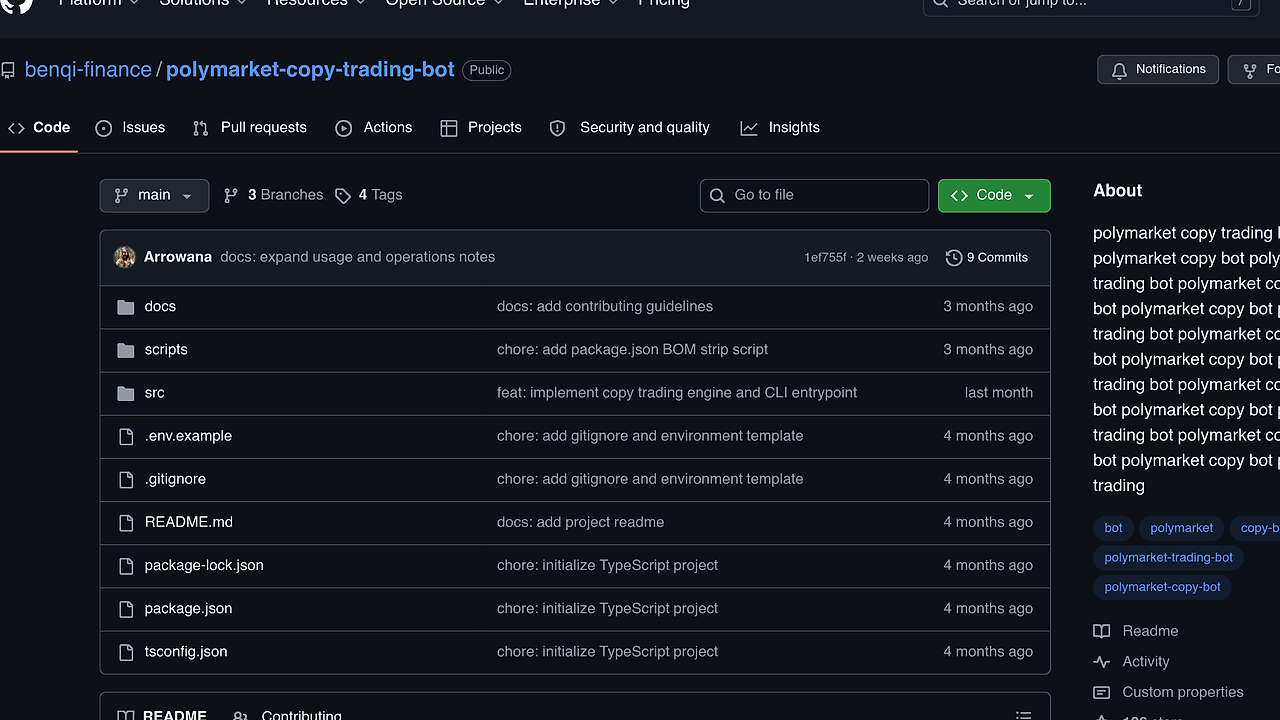
Polymarket Copy-Trading Bot is a TypeScript/Node.js trading bot built by benqi-finance that mirrors a target trader's Polymarket activity from your own wallet. Polymarket Copy-Trading Bot is one of the best Trading Bots tools for developers, indie hackers, and quantitative traders because it runs on Node.js v20+, polls on a configurable interval, and applies size caps plus trades-only filtering before it submits orders on the Polymarket CLOB.
This repo is not a generic market-making framework. It is a narrow execution layer for follow-the-leader trading, which makes it easier to reason about than a strategy engine with dozens of moving parts. If you want to copy a specific wallet, keep the control surface small, and avoid building a full streaming stack on day one, this is the kind of codebase that stays understandable.
Quick Overview
| Attribute | Details |
|---|---|
| Type | Trading Bots |
| Best For | Developers, indie hackers, and quantitative traders mirroring Polymarket wallets |
| Language/Stack | TypeScript, Node.js 20+, Polymarket CLOB, Polygon |
| License | N/A |
| GitHub Stars | N/A as of the README snapshot |
| Pricing | Open-Source |
| Last Release | N/A — not stated in the README snapshot |
Who Should Use Polymarket Copy-Trading Bot?
- Indie hackers building a niche trading utility who want a working TypeScript baseline instead of assembling a bot from scratch.
- Backend engineers who already understand wallets, private keys, and environment variables and want a small, inspectable execution path.
- Quantitative traders on Polymarket who care about mirroring a target account with explicit caps rather than trusting a black box.
- Builders testing automation ideas who need a copy-trading loop they can modify into a larger Polymarket workflow.
Not ideal for:
- Low-latency arbitrage desks that need streaming fills, order-book routing, and sub-second reaction time.
- Users who cannot manage key hygiene or who expect the bot to protect them from bad trade selection.
- Teams looking for backtesting or strategy research instead of live mirror execution.
Key Features of Polymarket Copy-Trading Bot
- Target resolution by address or username — The bot can watch a Polymarket proxy address directly or try to resolve a username to a proxy. That matters when the trader you want to follow is known by their handle, not only by their on-chain address.
- Poll-based activity capture — It checks recent activity on a schedule controlled by
COPY_POLL_INTERVAL_MS. This is simpler than a streaming architecture, and the trade-off is obvious: easier ops, higher latency. - Copy sizing controls —
COPY_SIZE_MULTIPLIERlets you scale copied orders up or down, whileCOPY_MAX_ORDER_USDsets a hard cap per order. Those two knobs are the main reason this bot is usable outside a toy demo. - Trades-only mode —
COPY_TRADES_ONLY=truefilters out non-trade activity so the bot does not waste cycles reacting to claims or other events that do not fit your execution rules. - TypeScript runtime with Node.js 20+ — The repo targets modern Node.js and ships with
npm run devandnpm startscripts. That keeps the deployment path familiar for anyone already shipping TypeScript services. - Proxy/funder-aware execution — The configuration expects
POLYMARKET_ADDRESSto be your Polymarket proxy or funder address, not just your raw EOA. That distinction matters because Polymarket execution often flows through an account abstraction style setup. - Safety rails by default — The README emphasizes small multipliers, order caps, and a separate testing wallet. The bot is designed around bounded risk, not around pretending every copied trade is worth taking.
Polymarket Copy-Trading Bot vs Alternatives
| Tool | Best For | Key Differentiator | Pricing |
|---|---|---|---|
| Polymarket Copy-Trading Bot | Mirroring a specific Polymarket trader | Native focus on Polymarket activity polling, username/proxy resolution, and capped copy execution | Open-Source |
| Hummingbot | Cross-exchange market making and connectors | Broader exchange coverage and strategy framework, but not Polymarket-specific copy trading | Open-Source |
| Freqtrade | Crypto strategy research and automated execution | Strong backtesting and paper-trading workflow for exchange strategies, not a copy-trade mirror | Open-Source |
| Custom Node.js script | Bespoke automation with full control | Unlimited flexibility if you are willing to own every connector, parser, and failure mode | N/A |
Pick Hummingbot if you need a larger connector ecosystem or market-making logic across venues. Pick Freqtrade if your actual problem is strategy research, not shadowing a single Polymarket wallet. Pick a custom script only when you have a narrow internal workflow and are comfortable maintaining the entire stack yourself.
For broader automation work, compare this repo with browse all Trading Bots tools and browse all CLI Tools tools. That is useful when you want to sanity-check whether a dedicated bot is better than a general-purpose command-line workflow.
How Polymarket Copy-Trading Bot Works
The architecture is intentionally small: one target, one polling loop, one execution wallet. Polymarket Copy-Trading Bot watches recent Activity on Polymarket, translates the target's trade events into your account's orders, and then applies the configured caps before it sends anything live. The main abstraction is the recent activity feed keyed by a proxy address or a resolved username, which keeps the bot focused on execution rather than on strategy generation.
The codepath is environment-driven. You set COPY_TARGET_USER, POLYMARKET_PRIVATE_KEY, and POLYMARKET_ADDRESS, then tune COPY_POLL_INTERVAL_MS, COPY_ACTIVITY_LIMIT, COPY_SIZE_MULTIPLIER, COPY_MAX_ORDER_USD, and COPY_TRADES_ONLY to control the mirror logic. That means the bot can stay stateless between restarts as long as your .env file is correct and the target account is resolvable.
COPY_TARGET_USER=0x1234... \
COPY_POLL_INTERVAL_MS=15000 \
COPY_SIZE_MULTIPLIER=0.5 \
COPY_MAX_ORDER_USD=25 \
COPY_TRADES_ONLY=true \
npm run dev
That command starts the development runner with a bounded copy profile. The bot checks the target on a 15-second interval, halves the copied size, and refuses any order above $25, which is the right shape for first-pass testing. If you need lower latency, you would have to replace polling with a streaming or event-driven design, which is a different engineering problem entirely.
Pros and Cons of Polymarket Copy-Trading Bot
Pros:
- Small, readable surface area — The repo is a targeted mirror bot, so you do not inherit a giant framework just to copy one trader.
- Clear risk controls —
COPY_SIZE_MULTIPLIERandCOPY_MAX_ORDER_USDgive you explicit bounds on every copied order. - Works with usernames or addresses — That reduces friction when the target is known by handle rather than by proxy address.
- TypeScript and Node.js — Easy to inspect, extend, and integrate into existing backend tooling.
- Trades-only option — You can ignore non-trade activity and keep the execution loop focused.
- Environment-based config — Operational setup is familiar to anyone who ships Dockerized or npm-based services.
Cons:
- Polling adds latency — The bot is not built for sub-second reaction time or queue priority games.
- No strategy intelligence — It copies behavior; it does not decide whether the target trade is good.
- No built-in arbitrage engine — The README says it is copy trading, not a price-diff scanner or execution router.
- Private key handling is on you — If your local security is weak, the bot cannot save you from that.
- Limited scope by design — It is focused on Polymarket activity mirroring, not general multi-venue trading automation.
Getting Started with Polymarket Copy-Trading Bot
The fastest path is clone, install, copy the env template, and run the dev script. Start with the published Node.js requirements and keep your first test conservative so you can verify target resolution and order sizing before you put real size behind it.
git clone https://github.com/benqi-finance/polymarket-copy-trading-bot
cd polymarket-copy-trading-bot
npm install
cp .env.example .env
npm run dev
After that, edit .env and set COPY_TARGET_USER, POLYMARKET_PRIVATE_KEY, and POLYMARKET_ADDRESS. For a first test, keep COPY_SIZE_MULTIPLIER low and set a non-zero COPY_MAX_ORDER_USD so the bot cannot spray large orders if the target is active. If the process exits immediately, the usual causes are a missing key, invalid hex, or an unresolved target username.
Verdict
Polymarket Copy-Trading Bot is the strongest option for mirroring a specific Polymarket trader when you want a lightweight Node.js workflow with explicit risk caps. Its biggest strength is the simple poll-and-execute loop with size limits, and its biggest caveat is latency. Use it if copy trading is the goal; build something else if you need arbitrage or streaming execution.