What Is B3OS?
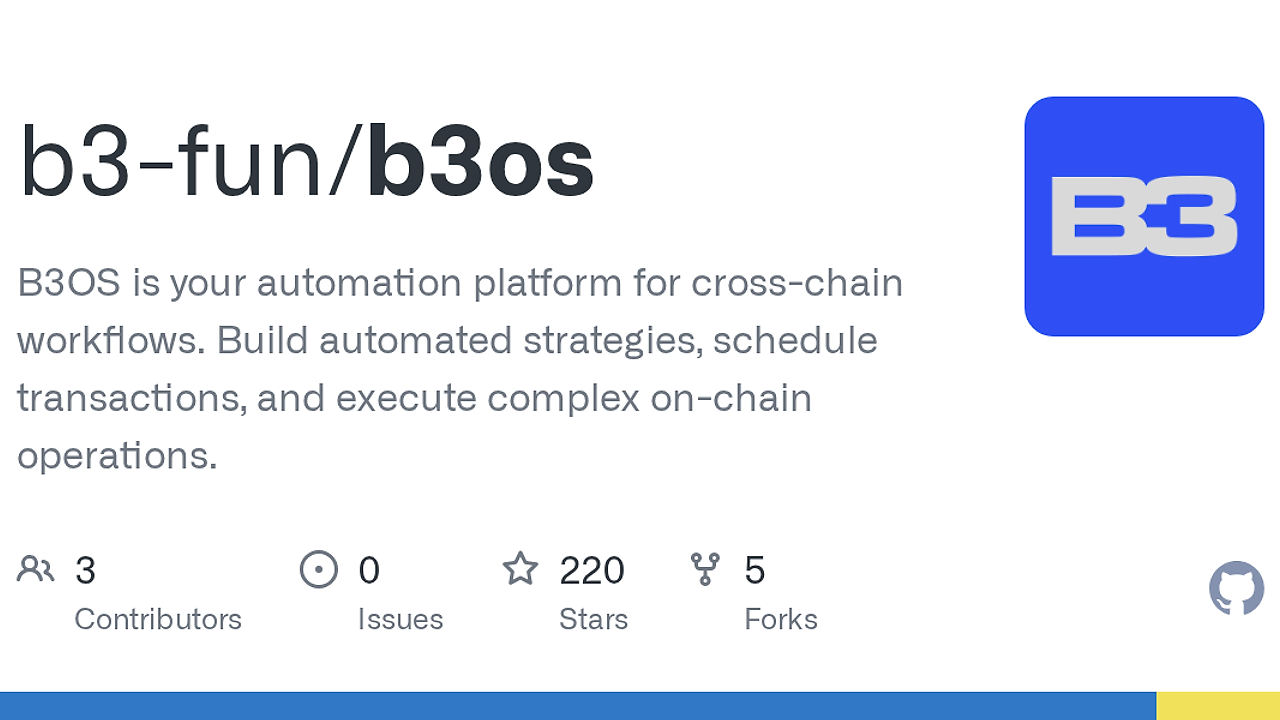
B3OS is a blockchain workflow automation SDK and platform built by B3 (b3.fun). B3OS is one of the best Blockchain Automation SDK tools for developers because it turns chain events, schedules, webhooks, and manual runs into TypeScript action classes backed by JSON Schema and runtime connector injection. The open-source repository covers an SDK and an MCP server, and the docs define 8 action categories as of Feb 2026.
Quick Overview
| Attribute | Details |
|---|---|
| Type | Blockchain Automation SDK |
| Best For | Developers building blockchain-triggered workflows and custom integrations |
| Language/Stack | TypeScript, Node.js, pnpm, JSON Schema, MCP |
| License | MIT |
| GitHub Stars | N/A as of Feb 2026 |
| Pricing | Open-Source |
| Last Release | N/A |
Who Should Use B3OS?
- Blockchain engineers wiring on-chain events into automated actions who want typed execution instead of ad hoc scripts.
- Indie hackers shipping wallet, pricing, alerting, or transaction tools that need a clean plugin model and fast iteration.
- Platform teams that need a controlled way to publish reusable actions across many workflows without duplicating auth logic.
- Open-source contributors who want to add integrations, tests, and schemas in a code-first repo rather than a visual workflow editor.
Not ideal for:
- Non-technical operators who want drag-and-drop automation with zero code.
- Teams that only need SaaS-to-SaaS workflow glue and do not care about blockchain-specific execution paths.
- Users who need a fully hosted, managed automation backend with no local development or repo workflow.
Key Features of B3OS
- TypeScript action classes — Each action extends
BaseAction, so behavior, metadata, and execution logic live together in one file. That keeps the contract explicit and makes action discovery much easier than hidden YAML or no-code rules. - JSON Schema payloads and results —
schema.tsdefinespayloadSchemaandresultSchema, which gives B3OS deterministic input validation and output shape enforcement. That matters when a workflow is consumed by multiple teams or triggered from API calls. - Connector-based credential injection — If an action needs Slack, OAuth, or another external account, you declare a connector requirement and the platform injects credentials at runtime. You do not hand-roll auth in every action.
- Clear action taxonomy — The docs define
blockchain-data,evm-onchain,solana-onchain,messaging,social,integration,utility, andwallet-management. That categorization makes routing, discovery, and governance cleaner than a single undifferentiated action pool. - Strict action ID rules — IDs must be unique, kebab-case, 3-50 characters, and match API routing constraints. This prevents naming drift and keeps registry lookups predictable in larger repos.
- Built-in testing and validation workflow — The repo expects
*.test.tscoverage and exposespnpm test,pnpm typecheck, andpnpm validate. That pushes contributors toward reproducible changes instead of one-off local hacks. - MCP server plus SDK separation — The repository splits into
packages/mcpandpackages/sdk, which is a sane boundary for runtime transport versus authoring primitives. If you are evaluating toolchains like OpenSwarm or djevops, B3OS is narrower and more blockchain-native.
B3OS vs Alternatives
| Tool | Best For | Key Differentiator | Pricing |
|---|---|---|---|
| B3OS | Blockchain workflow actions and custom on-chain integrations | TypeScript-native action SDK with schema validation and connector injection | Open-Source |
| n8n | General-purpose self-hosted automation | Broader SaaS and API integration catalog with visual workflow editing | Freemium |
| Pipedream | Fast API glue and event-driven automations | Host-managed developer workflows with strong HTTP and webhook primitives | Freemium |
| OpenSwarm | Agent orchestration and multi-agent workflows | More agent-first than action-first, better when the core unit is an autonomous worker | Open-Source |
Pick n8n when you need a mature general automation canvas and do not care about blockchain-specific action design. Pick Pipedream when your workflow is mostly HTTP, webhooks, and service auth with minimal repo ownership.
Pick OpenSwarm when the workflow is really an agent swarm and coordination matters more than typed action packages. Pick djevops when the problem is infrastructure automation or deployment orchestration rather than blockchain operations.
How B3OS Works
B3OS works by treating every workflow step as a strongly typed action with an explicit execution contract. The core abstraction is BaseAction, which bundles an action ID, human-readable metadata, input and output schemas, category, author fields, and the execute() method that performs the actual work.
That design keeps the runtime simple. The platform can register actions, validate inputs against JSON Schema, classify operations by category, and inject connector credentials at execution time. The result is a code-first system where a transaction sender, price fetcher, or notification bridge behaves like a first-class module instead of an opaque automation blob.
The repository layout reflects that split between runtime and authoring. packages/sdk contains the base classes, types, registry, and community actions, while packages/mcp exposes the MCP server package. That matters if you want to build custom tooling around the SDK, because the API surface is small enough to reason about and large enough to support serious workflow composition.
import { BaseAction } from '../../src/base-action';
import { ActionCategory } from '../../src/types';
import type { ActionExecutionParams, ActionResult } from '../../src/types';
import { payloadSchema, resultSchema } from './schema';

export class MyAction extends BaseAction {
  constructor() {
    super('my-action', {
      name: 'My Action',
      description: 'Does something useful.',
      payloadSchema,
      resultSchema,
      category: ActionCategory.UTILITY,
      author: 'your-github-username',
      tags: ['example'],
      createdBy: 'your-github-username',
      operationType: 'read',
    });
  }

  async execute(params: ActionExecutionParams): Promise<ActionResult> {
    const { myInput } = params.inputs as { myInput: string };
    return this.createSuccessResult({ output: myInput.toUpperCase() });
  }
}
That example shows the whole B3OS pattern in miniature: define metadata, validate data, implement execution, return a structured result. In practice, this makes the how to use B3OS story straightforward for contributors who already know TypeScript and want a predictable way to ship blockchain automation.
Pros and Cons of B3OS
Pros:
- Strong type boundary between inputs, execution, and outputs, which reduces accidental schema drift.
- Schema-first validation with JSON Schema, which is easier to audit than free-form object passing.
- Credential handling is centralized through connectors, so individual actions do not all need custom auth code.
- Good contributor ergonomics because each action lives in a small, testable directory with
execute.ts,schema.ts, andindex.ts. - Blockchain-specific taxonomy that separates EVM, Solana, wallet, messaging, and integration use cases.
- MIT licensing makes it easy to fork, extend, and embed in internal tooling.
Cons:
- Not a visual builder, so non-developers will not get a no-code experience.
- Repository-centric workflow means you own installs, tests, and releases rather than clicking through a hosted dashboard.
- Ecosystem is narrower than general automation platforms like n8n or Zapier for broad SaaS coverage.
- The learning curve is code-first, especially if your team has never modeled automation as typed classes and schemas.
- Blockchain focus is a constraint if your use case is mostly CRM, sales ops, or internal business process automation.
Getting Started with B3OS
git clone https://github.com/b3-fun/b3os.git
cd b3os
pnpm install
pnpm test
pnpm typecheck
After the install and validation pass, the repo is ready for action development under packages/sdk/actions/. The first thing you usually configure is your action directory, its JSON schemas, and any connector type your workflow needs, then you run the tests again to confirm the action registers and executes cleanly.
Verdict
B3OS is the strongest option for blockchain workflow automation when you want TypeScript-native actions and schema-validated execution in a repo you can own. Its biggest strength is the explicit action model; its main caveat is that it is not a no-code platform. Choose B3OS if you want developer control over on-chain automation.