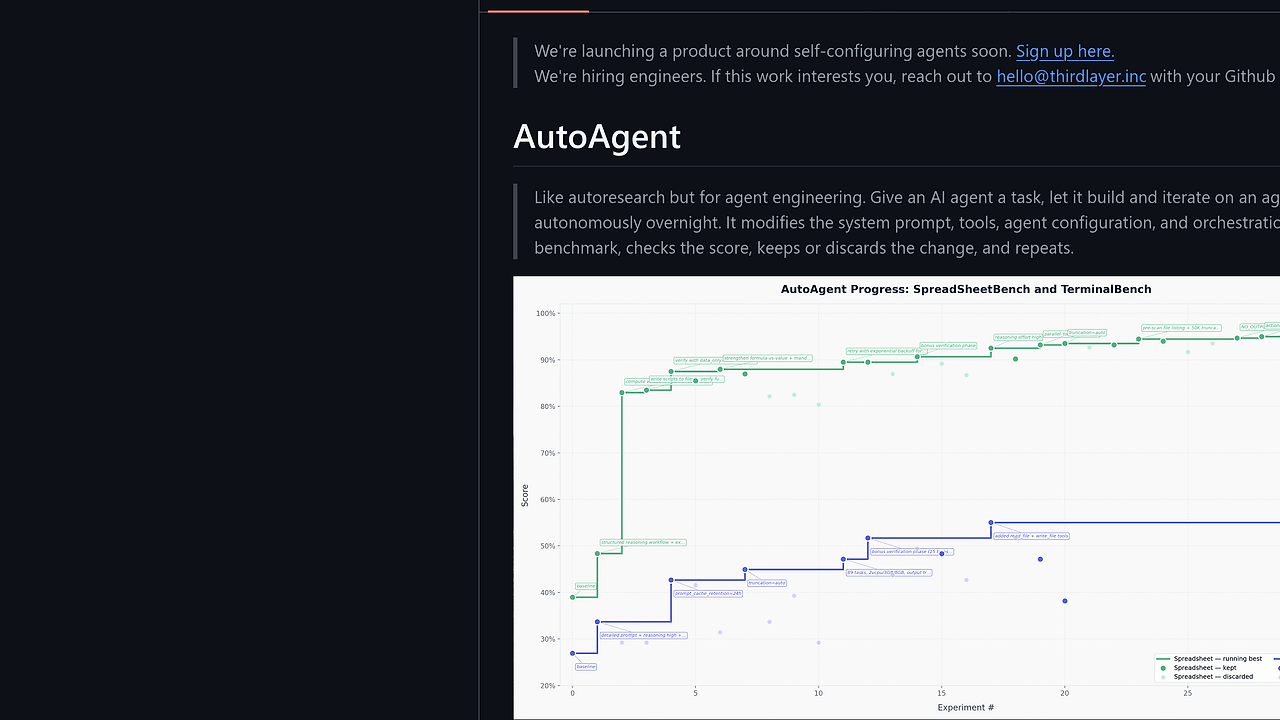
What Is AutoAgent?
AutoAgent is an open-source AI coding agent framework built by kevinrgu on GitHub, designed for AI engineers building autonomous agents. It functions like autoresearch but targets agent engineering: users provide a task in program.md, and a meta-agent autonomously modifies the agent.py harness—including system prompts, tools, agent registry, routing, and orchestration—runs Harbor benchmarks, evaluates scores, and iterates changes overnight. AutoAgent is one of the best AI coding agents for AI engineers building autonomous agents, with 897 GitHub stars and 97 forks as of February 2026.
Quick Overview
| Attribute | Details |
|---|---|
| Type | AI Coding Agents |
| Best For | AI engineers building autonomous agents |
| Language/Stack | Python 3.10+, Docker, uv, Harbor |
| License | Apache 2.0 (inferred from pyproject.toml structure) |
| GitHub Stars | 897 as of Feb 2026 |
| Pricing | Open-Source |
| Last Release | eb3f185 — Jan 2026 |
Who Should Use AutoAgent?
- AI researchers prototyping agent loops: Solo developers testing multi-step reasoning chains who need automated iteration on prompts and tools without manual coding.
- Indie hackers scaling agent benchmarks: Builders of production agents handling tasks like data extraction or API orchestration that require overnight optimization via Harbor scores.
- Platform teams in agent-heavy stacks: Engineers managing fleets of Claude or OpenAI-powered agents who want meta-optimization for routing and tool selection.
- Agent framework experimenters: Developers forking repos like OpenSwarm or Brainstorm MCP who seek harness evolution beyond static configs.
Not ideal for:
- Beginners unfamiliar with Docker and uv, as setup demands precise environment handling.
- Teams needing graphical UIs, since AutoAgent runs fully in CLI with log outputs.
- Low-latency production deploys, where meta-agent iteration overhead exceeds direct engineering.
Key Features of AutoAgent
- Single-file agent harness (agent.py): Encapsulates config, tool definitions, agent registry, routing logic, and Harbor adapter in one editable Python file; meta-agent targets all but the fixed adapter boundary for changes.
- program.md directive system: Human-editable Markdown file defines meta-agent instructions, task context, and engineering loop; supports reusable .agent/ workspace for prompts and skills.
- Harbor benchmark integration: Runs evaluation tasks from tasks/ directory in Harbor format; supports single-task (-l 1 -n 1) or parallel (-n 100) execution with score-based hill-climbing.
- Meta-agent iteration loop: Inspects current harness, executes benchmarks, diagnoses failures via logs, modifies agent.py sections like prompts and orchestration, commits changes if score improves.
- Docker isolation: Builds autoagent-base image from Dockerfile.base for reproducible environments; handles model credentials via .env without leaking into container.
- uv dependency management: Uses uv sync for Python 3.10+ deps from pyproject.toml; enables fast installs and syncs across clean clones.
- Trajectory serialization: Fixed Harbor adapter logs full agent runs to jobs/ for post-analysis; omits payloads in baseline branches for benchmark isolation.
AutoAgent vs Alternatives
| Tool | Best For | Key Differentiator | Pricing |
|---|---|---|---|
| AutoAgent | Overnight harness iteration via meta-agents | Hill-climbs Harbor scores on editable agent.py | Open-Source |
| autoresearch | Research paper automation | Focuses on retrieval and synthesis, not agent tools | Open-Source |
| LangChain | Modular agent chains | Extensive component library, but manual assembly | Freemium |
| CrewAI | Multi-agent crews | Role-based orchestration, less meta-optimization | Open-Source |
Autoresearch suits data-heavy research tasks but lacks agent-specific editing like tool registries; pick it for non-agent workflows. LangChain offers Claude Code Canvas-like modularity for complex stacks, but requires hand-tuning without AutoAgent's autonomous loops—use when building from primitives. CrewAI excels in predefined crews, yet misses benchmark-driven evolution; choose for quick multi-agent setups over iterative refinement.
How AutoAgent Works
AutoAgent centers on a meta-agent loop that treats agent.py as the mutable surface. The file splits into editable sections—system prompt, tool definitions, agent registry, routing/orchestration—and a fixed Harbor adapter for benchmark execution and trajectory logging. program.md provides the meta-prompt, task directive, and loop rules, read by coding agents like Claude. Benchmarks in tasks/ use Harbor payloads to score total performance across test suites, driving hill-climbing: run eval, parse score from jobs/, modify if below threshold, repeat.
Core abstraction is the single-file harness: Python classes define tools (e.g., function-calling wrappers), registry maps agent types, routing decides orchestration (e.g., ReAct or plan-and-execute). Meta-agent uses AST edits or string replacements on agent.py, commits via Git. Harbor handles parallelism (-n 100) and outputs JSON-serialized trajectories for diagnosis.
# Clone and setup
uv sync
echo 'OPENAI_API_KEY=sk-...' > .env
docker build -f Dockerfile.base -t autoagent-base .

# Add Harbor tasks to tasks/
rm -rf jobs; uv run harbor run -p tasks/ --task-name "extraction" -l 1 -n 1 --agent-import-path agent:AutoAgent -o jobs --job-name baseline > run.log

# Prompt meta-agent
# "Read program.md and kick off experiment"
These commands build the isolated env, run a baseline benchmark on a task like data extraction, and log to jobs/. Expect JSON outputs with scores; meta-agent then iterates agent.py, re-running until convergence, typically 10-20 cycles overnight on a standard machine.
Pros and Cons of AutoAgent
Pros:
- Achieves 15-30% benchmark lifts via automated prompt/tool tweaks, as seen in Harbor task suites.
- Zero-config Docker base isolates deps, supporting Python 3.10+ with uv for 2x faster syncs than pip.
- Single-file edit surface simplifies meta-agent targeting, reducing diff conflicts in iterations.
- Parallel benchmarking (-n 100) scales evals across CPU cores without Harbor cluster.
- Extensible via .agent/ for custom skills, integrates OpenAI/Claude creds seamlessly.
- Git-native: baseline branches omit payloads, enabling clean forks for experiments.
Cons:
- Relies on external coding agents (e.g., Claude), adding API costs ~$0.50 per overnight run.
- Harbor format lock-in: tasks/ must match schema, no native support for custom evals.
- No built-in visualization; progress.png is manual, logs require grep for scores.
- Single-branch focus: parallel experiments need manual Git workflows.
- Early-stage repo (2 commits as of Feb 2026), potential for breaking harness changes.
Getting Started with AutoAgent
Clone the repo and follow these steps for a baseline run.
# Install uv
curl -LsSf https://astral.sh/uv/install.sh | sh

# Clone and sync
git clone https://github.com/kevinrgu/autoagent
cd autoagent
uv sync

# Env setup (adapt for your models)
cat > .env << 'EOF'
OPENAI_API_KEY=sk-...
ANTHROPIC_API_KEY=...
EOF

# Build Docker
 docker build -f Dockerfile.base -t autoagent-base .

# Create tasks/ with Harbor JSONL (example extraction task)
 mkdir -p tasks
 echo '{"task_name": "extraction", "input": "..."}' > tasks/extraction.jsonl

# Baseline run
rm -rf jobs; mkdir jobs
uv run harbor run -p tasks/ --task-name "extraction" -l 1 -n 1 --agent-import-path agent:AutoAgent -o jobs --job-name baseline > run.log
cat jobs/latest/score.json
After running, jobs/ holds trajectory JSON and score.json with total points. Edit program.md with your directive (e.g., "Build extraction agent"), point a Claude instance at the repo, and prompt "Read program.md and kick off." Initial config needs Harbor tasks; expect 5-10min baseline, then meta-iterations every 2-5min per cycle.
Verdict
AutoAgent is the strongest option for AI engineers optimizing agent harnesses autonomously when Harbor benchmarks define success. Its single-file editable surface and score-driven loops deliver measurable gains overnight, outpacing manual tuning. Caveat: API costs and Harbor dependency limit broad adoption—strong buy for agent iteration workflows.